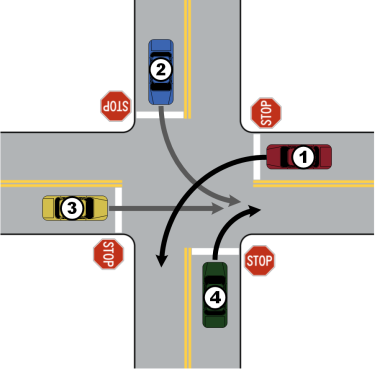
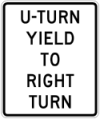
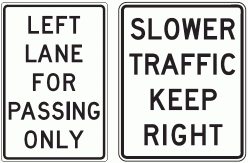
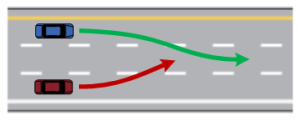
It's something most people in Texas do almost everyday: drive. And while there are plenty of just plain bad drivers out there, I believe that most people don’t mean to break traffic laws, but bad habits, distractions, and overconfidence can cause us to forget the rules. But every rule is there for a reason — even the ones that seem trivial are there to keep the roads safe, predictable, and running smoothly, and disregarded rules can lead to traffic disruptions at best and tragedy at worse. This page is intended to help those who want to learn or re-learn the rules and good habits.
To that end, below is a collection of Texas traffic laws that I have had questions about or personally see lots of people violating. I've also thrown-in some good driving habits that, if adopted, yield a safer, more efficient, or more pleasant driving experience for everyone.
I suspect most people who arrive here are searching for a specific topic, and I hope this page answers your question. But I also hope you'll take some time to review the other items on this page to get a good refresher on lesser-known traffic laws.
How this page is organized
Each section of this page addresses a specific topic; see the list of topics below. Whenever applicable, I usually first quote the relevant statute from the Texas Transportation Code, in which you'll find the state's traffic laws. Those references are in a gray box and include the section number (e.g. §545.066). In some cases, I omit sections of the statute not directly relevant to the topic at hand; I mark those omitted sections with "[...]". I then follow the statute with a more in-depth explanation in layman's terms, and include illustrations or examples where helpful. Occasionally, I'll include a discussion on a related subject.
Maybe you found this site after getting a ticket or being involved in an crash and having been cited with something you hadn't heard of before, or you dispute the allegation. Hopefully, you find the answer here, but if not, I encourage you to continue your search using the resources discussed above. In the end, you may find that the citation is valid. If that's the case, then take your medicine and pay the fine, or better, take a defensive driving course if allowed and consider it a learning experience. However, I have gotten messages from many folks that clearly indicate to me that sometimes even the police (who are human, after all) don't always get it right, so it's perfectly reasonable to double-check. Also, it's certainly not unheard of that traffic enforcement in many places is done for revenue enhancement, and officers may get overzealous and sloppy in their duties as a result.
Don't be that guy
I regularly see some drivers who I believe know they're breaking the law or are otherwise just making bad choices. One thing those drivers should think about is this: Aggressive, dangerous, or just plain bad driving significantly increases the chances that you'll get injured or killed. Besides the obvious risk from wrecks that such driving often causes, your actions could possibly enrage someone else to the point that they assault or even kill you, the phenomenon known as "road rage." Maybe you think you could handle such a situation, but some people "shoot first and ask questions later", so don't count on being able to fend off a confrontation. Instead, just keep cool, relax, and "drive friendly" — it could very well save your life.
Legal disclaimer
This page is provided for informational purposes only. What you see on this page is my own good-faith interpretation of the law backed by extensive research of official sources. If you need legal advice, get a lawyer as I am not a lawyer nor do I play one on TV. If it seems like I'm giving advice on a particular situation, you should interpret that to be my own personal musings on what I have done before or would do in that situation. I try to keep my site up-to-date, but I can't guarantee that something hasn't changed since the last time I checked. I don't rule the world, so I can't control or vouch for the accuracy of what's on other websites that I may suggest to you here. Be sure to eat at least five servings of vegetables and drink eight glasses of water every day. Do unto others as you would have them do unto you. Drive safely. Don't text while driving. Live long and prosper.
What I'm not but why this is pretty good info anyway
I'm not a lawyer, nor am I (nor ever have been) a traffic engineer or law enforcement officer. Therefore, the explanations below are technically those of a layman.
So why take my word for anything then? Well, I've had an inexplicable interest in roads and traffic since I was a youngster and have studied the Texas Transportation Code and Manual on Uniform Traffic Control Devices at length, and I've referenced multiple official sources to confirm my interpretations below. Furthermore, this page has been reviewed by numerous law enforcement officers, lawyers, and traffic engineers over the years and is often referenced by them I'm told. Additionally, this page has been cited or cribbed on numerous news reports, lawyer's websites, and even driver's education courses. (Imagine my surprise when I was helping my son with his driver's ed and saw part of this page in the course material!) I've even been invited to speak at a traffic lawyers convention. So I am quite confident in the accuracy of my interpretations and discussions below.
That all said, if you do find something you believe is incorrect, I'm happy to chat about it — use the contact link in the menu at the top of this page to reach me.
ADVERTISEMENT
Listing of topics
Below is a list of topics on this page grouped by major subject areas; some topics may fall under more than one major subject:
The officially-sanctioned meaning for lane markings is not in the Transportation Code. Instead, §544.001 requires the state to maintain an official manual of signs, signals, and markings. This manual, the Texas Manual on Uniform Traffic Control Devices (TMUTCD), is the "law" when it comes to all traffic control devices, including lane markings. The meanings of these devices, as defined in the TMUTCD, is enforceable.
Some lane markings seem to confound drivers. For example, many drivers don't realize the difference between white and yellow lines. So, without further ado, here are the definitions of lane markings in Texas:
YELLOW LINES: Traffic going opposite directions is separated by yellow lines. If you're to the left of a yellow line and you're not intentionally passing somebody, you'd better get over to the right FAST before you see the head ornament of a Mack truck directly in front of you. I see this confusion happen a lot when city folks get off the freeway onto a rural, two-way frontage road. There are various types of yellow lines; see below for the specifics of each.
SOLID DOUBLE YELLOW LINES: Two yellow lines separated by a small gap indicate that passing (overtaking) is not permitted (in other words, a no passing zone). Even if you think you can see far enough ahead, there may be some other hazard or reason that you can't see that makes it unsafe for you to pass. However, it is legal to turn left across a double yellow line with one exception; see "Turning left over double-yellow lines" below.
SINGLE SOLID YELLOW LINE: This is used to mark the left edge of the roadway on a divided highway or separate the left shoulder from the through lane. The use of this marking to mark the center of a two-way road is non-standard and has no official meaning.
SOLID YELLOW LINE ON YOUR SIDE, BROKEN YELLOW LINE ON THE OTHER: You may not pass when there is a solid yellow line on your side. Traffic on the side of the road with the broken (dashed) line is allowed to pass. Two sets of these, with the broken lines facing each other, are used to demarcate two-way center left turn lanes.
BROKEN YELLOW LINE: A single broken (dashed) yellow line means that passing is permitted in both directions.
BROKEN DOUBLE YELLOW LINES: This marking is fairly rare and is used to separate reversible lanes (i.e. lanes that can periodically change direction). Pay attention to and obey the lane control signs or signals.
WHITE LINES: These separate traffic going the same direction. There are several varieties of white lines; see below for the meanings of each.
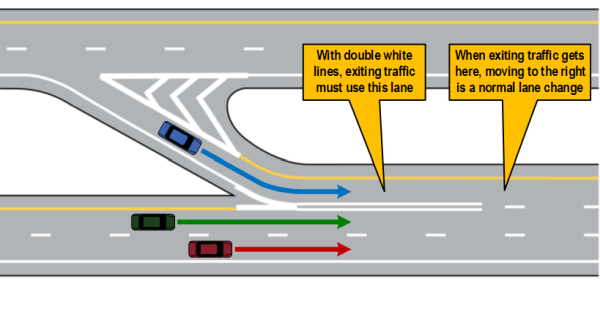
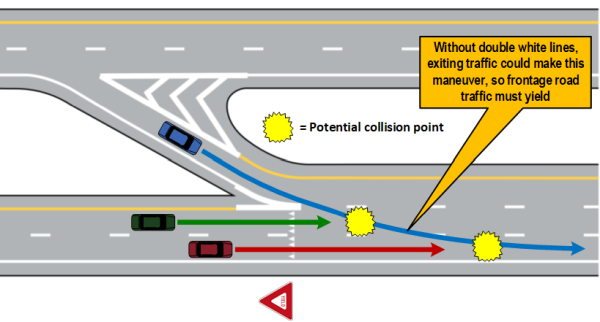
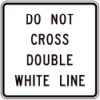
DOUBLE WHITE LINES: Parallel white lines separated by a small gap indicate that changing lanes or turning across the lines is prohibited. Doing so may be dangerous or interrupt the smooth flow of traffic. In Texas, you'll most often see these where an exit ramp continues into its own lane on the frontage road (see the "Yielding on frontage roads" section below).
SINGLE SOLID WHITE LINE: This is used to channelize traffic and indicates that changing lanes is discouraged, although not specifically prohibited. You can cross it if you have to, but you should avoid it if possible. Even a thick single white line can be crossed if necessary; however, they are really discouraging you from crossing, so you should think twice about it. Note that there is an exception; see "Crossing a single white channelizing line" below. A single white line is also used to mark the right edge of the roadway or separate the right shoulder from the through lane.
BROKEN WHITE LINE: A broken (dashed) white line separates lanes of traffic traveling in the same direction. You can freely change lanes when it is safe to do so.
SHORT BROKEN WHITE LINE:
A short broken (dotted) white line marks a lane that will soon become an exit or turn-only lane. Short broken lines are also used to mark lanes through an intersection (sometimes called "puppy tracks").
Crossing a single white channelizing line
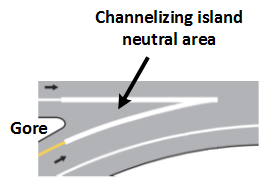
In the explanation above, it is noted that crossing a single white line — even a thick one — is allowed. However, there is an exception to that: the channelizing island. This is when there are two single white lines that are converging or diverging in a roughly triangular shape. The area between the lines in this case is known as a "neutral area" or "dividing space" in which vehicles are not allowed because it is considered an extension of the physical island and crossing it interferes with the smooth merging or diverging of traffic.
Turning left over double-yellow lines
A big misconception in the arena of lane markings is the meaning of the double-yellow line with regards to left turns. A double-yellow line simply means "no passing"; it does not prohibit left turns. In fact, you are specifically permitted by statute to turn left over double yellow lines:
§545.055. PASSING TO THE LEFT: PASSING ZONES
[...]
(b) An operator may not drive on the left side of the roadway in a no-passing zone or on the left side of any pavement striping designed to mark a no-passing zone. This subsection does not prohibit a driver from crossing pavement striping, or the center line in a no-passing zone marked by signs only, to make a left turn into or out of an alley or private road or driveway.
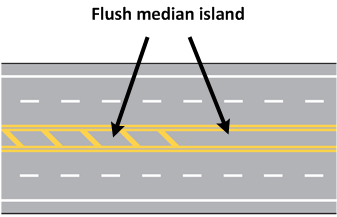
Of course, as always, there is an exception to the above rule: if there are two sets of double-yellow lines, you may not cross over at all, including for left turns. These areas are defined as "flush median islands" in the TMUTCD. As such, they have the same purpose and function as a physical traffic island and are legally enforceable as a "dividing space" for the purposes of §545.063(b) (see the "Crossing medians" section below). These areas often also have diagonal hash markings to help emphasize that they're off-limits.
Yellow traffic signal
§544.007. TRAFFIC-CONTROL SIGNALS IN GENERAL
[...]
(e) An operator of a vehicle facing a steady yellow signal is warned by that signal that:
(1) movement authorized by a green signal is being terminated; or
(2) a red signal is to be given.
Lots of folks have questions as to just what a yellow light really means. By law, a yellow light is simply a warning that the light is about to change to red. Technically, since no conflicting traffic can have a green while you have a yellow, you still have the right-of-way — it's really just an extension of the green but letting you know that the green is ending. Therefore, you are still allowed to cross the stop line or crosswalk when the light is yellow, and as long as you have done so before the light turns red, you have not violated the law.
Now, does this mean you should race to beat the red — no, of course not. If the light is yellow and you have not passed the "point of no return" and can safely stop, you should do so. Note, however, that I said "safely" stop. If the road is wet and you don't reasonably think you could stop without sliding into the intersection or perhaps having the guy behind you slide into you, then keep going (carefully, of course) — your duty to prevent a crash is foremost.
Flashing yellow signals
§544.008. FLASHING SIGNALS
(a) The operator of a vehicle facing a flashing red signal shall stop at a clearly marked stop line. In the absence of a stop line, the operator shall stop before entering the crosswalk on the near side of the intersection. In the absence of a crosswalk, the operator shall stop at the place nearest the intersecting roadway where the operator has a view of approaching traffic on the intersecting roadway. The right to proceed is subject to the rules applicable after stopping at a stop sign. (b) The operator of a vehicle facing a flashing yellow signal may proceed through an intersection or past the signal only with caution.
(c) This section does not apply at a railroad crossing.
This signal does NOT mean stop!
Quite a few motorists seem to be confused about the meaning of a flashing yellow signal, particularly when a regular red-yellow-green traffic signal is flashing yellow. (I'm specifically talking about a full
circular flashing yellow like the one shown at the right, not flashing yellow arrows.)
A flashing yellow signal simply means "proceed with caution", whether it's being displayed by a dedicated flashing yellow beacon or a regular traffic signal. Inexplicably, I often see people actually stop when they come upon a one of these. This is unnecessary and can be dangerous because the person behind you is likely not expecting you to stop. It would be the same as stopping at a green light. It can also be dangerous because it could confuse the other driver, who may then enter the intersection thinking you have a flashing red. If other vehicles are approaching the intersection, they then may have to stop suddenly to avoid a crash.
You only need to stop if it is a flashing red signal, in which case you should treat the signal like you would a stop sign. Otherwise, just proceed through with a bit of extra caution since a driver on the intersecting street might think you have a flashing red and suddenly pull out into the intersection expecting you to stop.
Most traffic signals will default to flash mode as a fail-safe measure if there has been a malfunction, or if there was a power outage and the signal did not properly reset. Some signals also go into flash mode during overnight hours or if there is a train at an adjacent crossing, and brand new signals are typically run in flash mode for a few days before being fully activated (this is done to burn in the electronics as well as to give regular commuters notice that the signal will be activated soon). In some cases, the signals will flash red for all directions, but in many cases, the main road will get a flashing yellow while the minor road will get a flashing red.
Traffic signals out
§544.007. TRAFFIC-CONTROL SIGNALS IN GENERAL
[...]
(i) An operator of a vehicle facing a traffic-control signal, other than a freeway entrance ramp control signal or a pedestrian hybrid beacon, that does not display an indication in any of the signal heads shall stop ... as if the intersection had a stop sign.
This signal DOES mean stop!
If a traffic signal is out of order — that is, all of the lights are dark — then the intersection reverts to an all-way stop. Many drivers falsely (and dangerously) just assume that if the light is off, they can just ignore it and keep going as if it wasn't there. But if someone on the intersecting street is thinking the same thing at the same time, then you can guess what's likely to happen.
Common sense also dictates that if the signals are otherwise obviously malfunctioning (e.g. two colors on at the same time, stuck on solid yellow, etc.), treat the intersection as a four-way stop as well.
Note that this statute does not apply to signals on freeway entrance ramps (metering or "flow" signals) as well the new "HAWK" pedestrian crossing signals that are dark until activated.
This also doesn't apply to signals that are covered (usually in a black bag) or turned sideways or upward to clearly indicate they're not in service. In those cases, treat the intersection like you would if there were no signals at all. (In nearly all cases, there should be other right-of-way control, i.e. signs.)
Turning on red
§544.007. TRAFFIC-CONTROL SIGNALS IN GENERAL
[...]
(d) An operator of a vehicle facing only a steady red signal shall stop at a clearly marked stop line. In the absence of a stop line, the operator shall stop before entering the crosswalk on the near side of the intersection. A vehicle that is not turning shall remain standing until an indication to proceed is shown. After stopping, standing until the intersection may be entered safely, and yielding right-of-way to pedestrians lawfully in an adjacent crosswalk and other traffic lawfully using the intersection, the operator may:
(1) turn right; or
(2) turn left, if the intersecting streets are both one-way streets and a left turn is permissible.
[...]
(f) The Texas Transportation Commission, a municipal authority, or the commissioners court of a county may prohibit within the entity's jurisdiction a turn by an operator of a vehicle facing a steady red signal by posting notice at the intersection that the turn is prohibited.
Below are three common questions related to legal turns on red. But first, it's important to note that you are required to make a full stop before making a turn on red.
Left on red
Whenever I drive downtown, I often end-up stuck behind someone on a one-way street stopped at a red light waiting to turn left onto another one-way street with no traffic coming. If only they knew that they were wasting their time (and mine) sitting there!
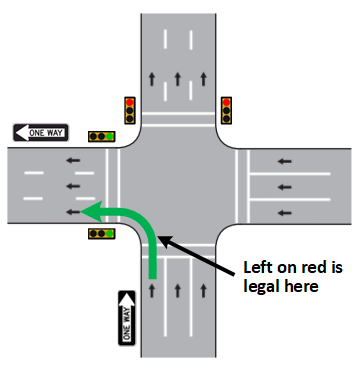
A left turn on red is allowed when the street you are on is one-way and the street you are turning onto is also one-way (to the left, of course). It makes sense if you think about it — it's just a mirror image of a right on red.
There are a handful of states that allow a left on red from a two-way to one-way street, but Texas does not. Unless both streets are one-way, you cannot make a left on red.
Some folks will assert that you can make a left on red if there are no signs such as "LEFT TURN SIGNAL" or "LEFT ON GREEN ARROW". However, those signs are purely informational, and as long as a signal is obviously intended to regulate traffic turning left — which a red left arrow or a red circular signal to the left of green signals for through traffic would be — then drivers are required to obey it regardless of the absence of any signs.
Right on red from double turn lanes
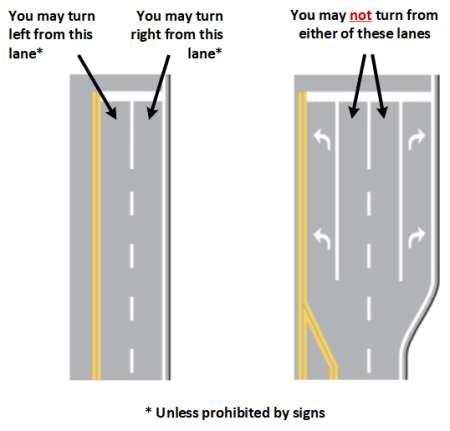
I often get the question of whether it is legal to make a right on red from both lanes when there are multiple right-turn lanes. The law simply states that you can turn right on red after stopping; it doesn't specify to which lane(s) it applies. As a result, you can turn right on red from any lane where you can legally turn right so long as there aren't any signs prohibiting it such as those shown below.
Right on red with red arrow
Until recently, there was a conflict between the Texas Manual on Uniform Traffic Control Devices (TMUTCD) and state law regarding a red arrow traffic signal and turning right on red, with the TMUTCD specifically stating a red arrow signal prohibited such a turn, while state law allows it because it does not differentiate between a circular red and a red arrow. Fortunately, the authors of the 2025 TMUTCD update apparently recognized the conflict, and the wording in the TMUTCD has now been changed to correspond with the statute. Specifically, section 4A.03 states, "Except when a traffic control device is in place prohibiting a turn on red, vehicular traffic facing a steady RED ARROW signal indication is permitted to enter the intersection to make the movement indicated by the arrow signal indication to turn right, or to turn left from a one-way street into a one-way street, after stopping."
The upshot is there is no more ambiguity — a right turn on a red arrow is legal in Texas (after stopping, of course). And this is actually the case in the majority of states, but if you're driving out-of-sate, be aware that in 15 states and DC, a red arrow does prohibit a right turn on red.
Stopping in intersections
§545.302. STOPPING, STANDING, OR PARKING PROHIBITED IN CERTAIN PLACES
(a) An operator may not stop, stand, or park a vehicle:
[...]
(3) in an intersection;
[...]
(f) Subsections (a), (b), and (c) do not apply if the avoidance of conflict with other traffic is necessary or if the operator is complying with the law or the directions of a police officer or official traffic-control device.
The issue of stopping in an intersection is a little tricky. The law specifically prohibits it. However, subsection (f) of the statute makes an important exception. Therefore, the following sections cover the two conflicting issues regarding when to wait in an intersection. Confoundingly, many people do exactly the opposite of these.
Waiting to turn left
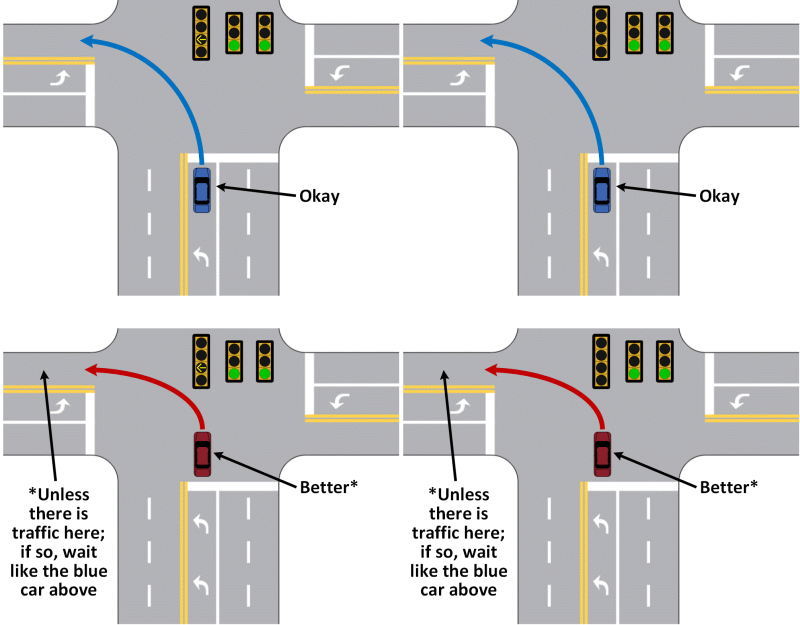
Sometimes, you come to an intersection where you want to turn left and there's a flashing yellow arrow or a green circular signal and no green arrow. You may have seen people pull into the intersection and wait to turn left there and thought they were breaking the law. But actually, they aren't.
But how is that the case when §545.302(a)(3) specifically prohibits stopping in an intersection? In this case, subsection (f) makes an exception "if the avoidance of conflict with other traffic is necessary". If you were to turn left in front of oncoming traffic, that would be conflicting with that traffic. Therefore, stopping so as to not conflict with oncoming traffic fulfills subsection (f), which then exempts you from the (a)(3) prohibition on stopping in an intersection.
But wait a minute... If you're still in the intersection when the light turns red, what do you do? The answer is wait for oncoming traffic to stop, then complete your turn. But wouldn't that then be considered running a red light? No, because you lawfully entered the intersection while the signal was green and other traffic must by law allow you to clear the intersection before they can go (§544.007 (b)).
So why would you want to do this? Because it reduces your wait time, reduces pollution, and helps reduce congestion. For every car that makes it through the intersection each cycle, that's one less car idling in line. The more people that do this, the more the benefit compounds. At larger intersections, multiple cars could turn when the light turns red, making the line that much shorter during the next cycle.
Waiting in the intersection — also sometimes known as "controlling the intersection" — also puts you in a better position to make a quick turn when traffic permits, enabling you to take advantage of smaller gaps. And at intersections without protected left arrows on busy streets, you often have to do this if you ever want to turn.
With that said, there are some important caveats:
First of all, don't do this if the street you want to turn onto is congested and backed-up to the intersection or nearly
so (see "But don't block intersections" below).
Secondly, if you're still in the intersection when your light turns red, make sure that the oncoming traffic is stopping before you actually turn — sometimes someone will be trying to beat the red.
Finally, sometimes oncoming traffic will still have a green even when your direction has a red. In these cases, there is supposed to be a sign that reads "ONCOMING TRAFFIC HAS EXTENDED GREEN", but I honestly have never seen one. If there is such a sign, you should wait behind the stop line. Fortunately, this doesn't happen with a flashing yellow arrow, which was developed specifically to eliminate this hazardous situation.
One final tip: always stop with your wheels pointed straight ahead. That way, if you're rear-ended, you won't be propelled into oncoming traffic.
Where to wait to turn left
Avoid backing out of an intersection
If you are waiting in an intersection to turn left when the light turns red, you should avoid backing out of the intersection. Just wait for oncoming traffic to stop, then complete your turn. Don't panic if this means you have to wait in the intersection for a few seconds after the light has turned red — just stay calm and wait until it's safe to turn. Signals typically incorporate an all-way red period after one direction turns red but before another direction turns green, so that should give you time to make your turn before you're in the way of other traffic. But, if anyone on the intersecting road honks at you, you can be secure in the knowledge that they're in the wrong.
But don't block intersections
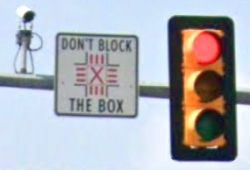
If the street you're on is bumper-to-bumper and you come to an intersection with a green light, remember: "Don't block the box!" You should not enter an intersection if congestion would prevent you from immediately vacating the intersection when the signal turns red. In other words, don't drive into an intersection unless you know you can get out quickly when the light turns red. Otherwise, you'll be stuck in the intersection blocking cross traffic.
So why doesn't the exception provided by subtitle (f) apply? In this case, you're not stopping to avoid conflicting with other traffic, you're stopping due to congestion, which is different. It's basically a matter of common sense and good faith in keeping with the spirit of the law. With the left-turn rule above, assuming there is nothing obstructing the street you want to turn onto, you will be able to vacate the intersection before or immediately after your light turns red and therefore won't be blocking the intersection for cross-traffic. With congestion, your egress is blocked by stopped traffic, which would prevent you from being able to exit the intersection immediately when the light turns red and thus will leave you blocking the intersection for other traffic.
By the way, this rule can also nullify the waiting-to-turn-left rule above: if you have a green light, flashing yellow arrow, or even a green arrow, but the street you want to turn onto is backed-up to the intersection, wait behind the stop line or crosswalk until there's room for you on the other street and oncoming traffic has cleared, then turn.
New York City had such a problem with blocked intersections that they started a public education program called "Don't Block the Box!", and several Texas cities have now adopted it as well. Obstructing intersections in this manner causes traffic on the intersecting street to also become congested. This leads to the phenomenon known as "gridlock" where several blocks of traffic in all directions are "locked" because of obstructed intersections.
Yield on green
Even if you have a green light, the law requires you to yield to traffic already in the intersection. So if someone on the cross street is hanging-out in the intersection waiting to turn left when your signal turns green, don't roar into the intersection and pound your horn — they're legally there and have the right to make their turn unmolested, and you're just being a putz by not giving them a few seconds to do so.
Right-of-way at intersection with signals and yield signs
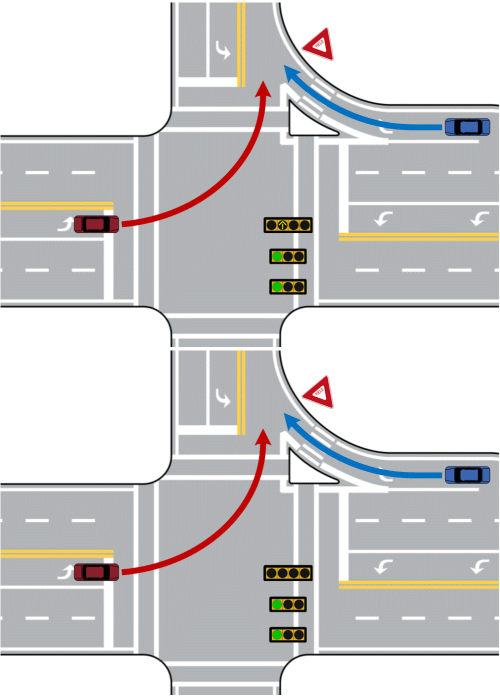
Many signalized intersections feature a dedicated right-turn lane with a yield sign that is separated from the main intersection by a triangular "pork chop" island. And, many such intersections have a flashing yellow arrow signal (or a non-protected green signal) that indicates that left turning traffic must yield. (See diagram above.) Right turns typically have the right-of-way over left turns, so some people believe that's the case at these intersections as well.
However, it is not.
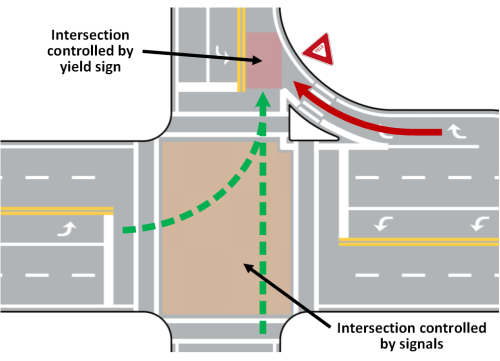
In this situation, the island creates a channelized "slip lane", which is in essence a separate roadway. As a result, the intersection of it with the cross street is a separate intersection from the main signalized intersection and, therefore, has its own traffic control — in this case (and in most cases) a yield sign for traffic turning right. As a result, drivers making that right turn must yield to all traffic coming from the left (green arrows in the diagram below) regardless of how that traffic got there. Drivers turning left with the flashing yellow arrow in this case are therefore only required to yield to oncoming traffic that is headed straight through the intersection.
Separate intersections created by channelized right-turn lane
Right-turning traffic (red arrow) must yield to any traffic approaching from the left (green arrows).
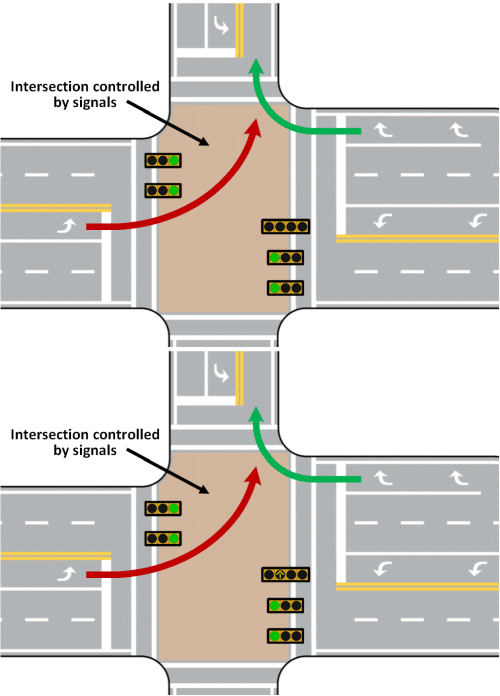
If the right-turn lane is not separated from the intersection by an island, then left-turning traffic with a flashing yellow arrow would have to yield to oncoming right-turning traffic. In that case, there won't be a yield sign for the right-turn lane. (See diagram below.) This would also apply if there is no dedicated right-turn lane.
As a footnote, the "pork chop" island can either be a physical island (concrete, grass, etc.), or it can just be marked with paint, although those are somewhat rare. But, beware that some paint-only islands do not constitute a slip lane. The main thing to look for is the yield sign. If there is one, then it is a slip lane. If there is no yield sign, and a single stop line extends across all the lanes including the right-turn lane, then it is NOT a slip lane.
Intersection with non-channelized right-turn lane
In this case, left-turning traffic (red arrow) must yield to oncoming right-turning traffic (green arrow).
Changing lanes in an intersection
It is a common belief that it is illegal to change lanes in an intersection. However, in Texas, and in every other state that I could find, there actually is no statute that specifically prohibits changing lanes in an intersection. Therefore, it is perfectly legal to change lanes in an intersection so long as it can be done safely (which is always the requirement when changing lanes).
Some will assert that §545.056 prohibits changing lanes in an intersection. However, that is an incorrect interpretation the statute. Here is the text of that statute:
§545.056. DRIVING TO LEFT OF CENTER OF ROADWAY: LIMITATIONS OTHER THAN PASSING
(a) An operator may not drive to the left side of the roadway if the operator is:
(1) approaching within 100 feet of an intersection or railroad grade crossing in a municipality;
(2) approaching within 100 feet of an intersection or railroad grade crossing outside a municipality and the intersection or crossing is shown by a sign or marking in accordance with Section 545.055;
(3) approaching within 100 feet of a bridge, viaduct, or tunnel; or
(4) awaiting access to a ferry operated by the Texas Transportation Commission.
(b) The limitations in Subsection (a) do not apply:
(1) on a one-way roadway;
Notice that the statute specifically says "an operator may not drive to the left side of the roadway". This means to cross the yellow center line and into oncoming traffic (for example, to overtake another vehicle). This is not the same as changing between two lanes going in the same direction. I suspect many people misconstrue or misremember this rule to mean that you can't change lanes at or approaching an intersection.
Occasionally, there are solid white lines between the through lanes on an approach to an intersection. As discussed in the "Lane markings" section above, a single solid white line discourages lane changes, but does not prohibit them.
But what if the road has a median creating separate roadways in each direction? Wouldn't the "left side of the roadway" then be the left lane going in the same direction, and therefore this statute would apply? No, because then the road on each side of the median is considered a one-way roadway, and thus exempted by subsection (b)(1).
Just because you can, doesn't mean you should
That said, you should avoid changing lanes while in or approaching an intersection, especially if you see someone waiting on the intersecting street. That person may decide to make a turn onto your roadway based on which lane you're in. For instance, if you're in the left lane, someone may use that as an opportunity to turn into the right lane. If you suddenly change into the right lane after they've committed themselves to making that turn, then you're creating a dangerous situation that may very well cause a crash. Also, changing lanes in an intersection can confuse other drivers because lane markings usually do not carry through the intersection, so another driver may not realize you're in the process of changing lanes, thus creating an unsafe situation. In those cases, you could be cited for an unsafe lane change, especially if it results in a collision.
This lane change is not explicitly prohibited, but not recommended.
ADVERTISEMENT
Look before crossing intersections
This is a short one, but still important: Even if you have a green light, you should always look both ways before you cross any intersection. You don't know... there could be somebody running the red or maybe an emergency vehicle approaching. So always look both ways before you cross any intersection, even if you have (or think you have) the right-of-way.
Stopping for school buses
§545.066. PASSING A SCHOOL BUS; OFFENSE
(a) An operator on a highway, when approaching from either direction a school bus stopped on the highway to receive or discharge a student:
(1) shall stop before reaching the school bus when the bus is operating a visual signal as required by Section 547.701; and
(2) may not proceed until:
(A) the school bus resumes motion;
(B) the operator is signaled by the bus driver to proceed; or
(C) the visual signal is no longer actuated.
(b) An operator on a highway having separate roadways is not required to stop:
(1) for a school bus that is on a different roadway; or
(2) if on a controlled-access highway, for a school bus that is stopped:
(A) in a loading zone that is a part of or adjacent to the highway; and
(B) where pedestrians are not permitted to cross the roadway.
[...]
(f) For the purposes of this section:
(1) a highway is considered to have separate roadways only if the highway has roadways separated by an intervening space on which operation of vehicles is not permitted, a physical barrier, or a clearly indicated dividing section constructed to impede vehicular traffic; and
(2) a highway is not considered to have separate roadways if the highway has roadways separated only by a left-turn lane.
It's been widely reported by numerous school districts and police agencies that many drivers either have no clue about the requirement to stop for school buses, are simply not paying attention, or frankly are in too big of a hurry to stop. (I hope it's not that last one, although nowadays, I realize that's probably often the case.)
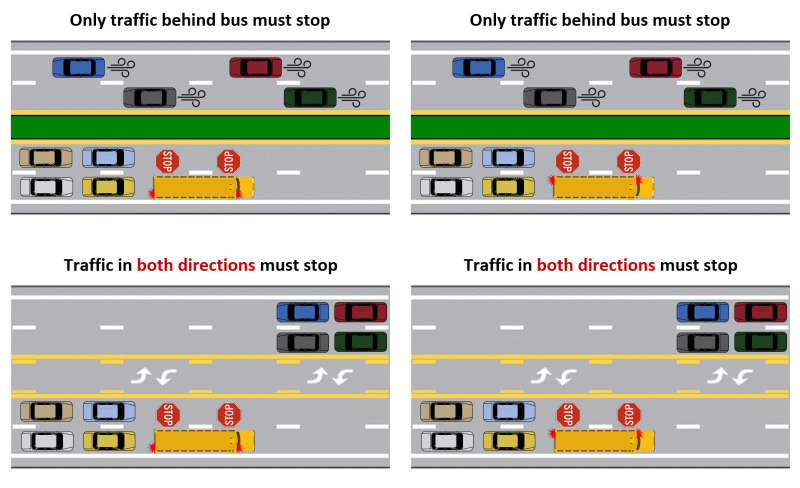
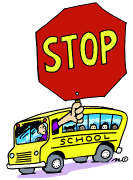
The law is simple: if you are approaching a school bus that has stopped and its red lights are flashing, you must stop. Most school buses also have one or more stop signs on the driver's side that swing out to remind you of your duty to stop. Traffic heading in both directions is required to stop (with one big exception discussed below), and the requirement to stop applies in both urban as well as rural areas.
Once you have stopped, you are required to remain stopped until the lights stop flashing, the bus has started moving again, or the driver waves you to move on.
Note that in Texas traffic code, the term "highway" is defined to mean any public roadway, including city streets (§541.302).
Exceptions
There are a couple of exceptions to the requirement to stop. One is if there is a median, island, divider, or other physical barrier between you and the school bus; in those cases, you can proceed, but you should do so cautiously (more on that a little further down).
Note that the law specifically indicates that a left-turn lane does NOT count as a divider — this means that even on a street that is three lanes in each direction, if it has a center left-turn lane, traffic in all seven lanes must stop for a school bus. The reason for the difference is that a median or island provides a safe place for pedestrians to wait for a break in traffic while a left-turn lane doesn't.
Some people will argue that, even if there is a median, they should stop anyway because kids may dart across the road. While this seems like a common-sense "better safe than sorry" approach, there are actually a few problems with it that make it dangerous:
Other drivers are not expecting you to stop, so doing so puts you at risk of causing a rear-end collision.
It is very rare that a school bus will drop off children who would need to cross a divided roadway. Instead, the bus will usually make a separate stop for them on the other side of the road.
If, by chance, a child were to cross to the median and you were to stop to allow them to cross, you could actually put them at greater risk of being hit. If you are in the left lane when you stop, the child will begin crossing in front of you and may think it is safe to continue across without checking the next lane. They may even decide to run. Another driver may be passing you on the right and they may not see each other in time to stop because your vehicle obstructs their vision.
So, even though you might think you are being safer by stopping, in this situation, you're actually not. Instead, you should reduce your speed and be prepared to stop if a child does happen to dart onto your side of the road.
The green strip in the top image is a grassy median but could also be a concrete median or barrier
There is also an exception for when a bus is stopped in a loading zone on a controlled-access highway (a fancy term for a freeway), but that's an "old school" artifact (see what I did there? 😏) as these no longer exist — at least, nowhere that I'm aware of.
Intersecting streets
A common question is whether you have to stop if a school bus is stopped at an intersection but is on the intersecting street; in other words, it's not on the same street you're on, and you're traveling straight through perpendicular to the bus or turning away from the bus.
In both cases, you are not required to stop.
In the example below, the blue car is on a separate roadway and therefore is not required to stop. The green car is not required to stop because the statute reads that you have to stop "when approaching" the bus and the green car is moving away. If the green vehicle had turned right, it would have been required to stop for the bus.
Neither vehicle is required to stop for the school bus
Even though you are not required to stop in these situations, you should proceed with extreme caution and be prepared to stop if a child enters the roadway unexpectedly.
Now, if you're approaching a school bus stopped across an intersection from you on the same street and you wish to turn before reaching the bus, that's less clear. In that case, it's probably best to stop.
As a footnote, I've seen some school bus drivers who will stop their bus in the intersection to make this all a moot point, although technically the school bus driver would then be stopped in the intersection illegally. In some places, stops are located mid-block to avoid any such issues.
School buses with hazard flashers on
School buses are required by law to stop at all railroad crossings. (That, BTW, was the subject of the bill in School House Rock's "I'm Just a Bill" song.) When they do this, they usually switch on their hazard flashers to warn traffic behind them of the impending stop. You are not required to stop for the bus in this case (unless you are directly behind them, of course). You are only legally bound to stop when the alternating red lights at the top of the bus are flashing.
You only have to stop when these lights are flashing
It should also be noted that sometimes when discharging or boarding passengers, the driver may determine that there is not a need to stop traffic — for example, when stopped in a loading area in front of a building — and they will only activate the bus' hazard flashers. Again, in this case, you are not required to stop; however, you should proceed with extreme caution.
Yellow flashing lights
Finally, most school buses also have yellow alternating flashing lights at the top of the bus next to the red ones. The meaning of these lights confuses many drivers. In short, these are used to warn drivers that the bus is about to stop, much like a yellow traffic signal warns that it's about to change to red. You are not required to stop when the yellow flashers are on, but you should slow down and be prepared to stop.
§545.156. VEHICLE APPROACHED BY AUTHORIZED EMERGENCY VEHICLE
(a) This section applies only to:
(1) an authorized emergency vehicle using audible and visual signals that meet the requirements of Sections 547.305 and 547.702;
(2) a medical examiner vehicle, as defined by Section 547.751, lawfully using a visual signal in accordance with that section;
(3) a vehicle operated by a justice of the peace for a purpose described by Section 547.752 and lawfully using a visual signal in accordance with that section; and
(4) a police vehicle lawfully using only an audible or visual signal.
(a-1) On the immediate approach of a vehicle described by Subsection (a), an operator, unless otherwise directed by a police officer, shall:
(1) yield the right-of-way;
(2) immediately drive to a position parallel to and as close as possible to the right-hand edge or curb of the roadway clear of any intersection; and
(3) stop and remain standing until the authorized emergency vehicle has passed.
(b) This section does not exempt the operator of an authorized emergency vehicle from the duty to drive with due regard for the safety of all persons using the highway.
§545.157. PASSING CERTAIN VEHICLES
(a) This section applies only to the following vehicles:
(1) a stationary authorized emergency vehicle using visual signals that meet the requirements of Sections 547.305 and 547.702;
(2) a stationary tow truck using equipment authorized by Section 547.305(d);
(3) a Texas Department of Transportation vehicle not separated from the roadway by a traffic control channelizing device and using visual signals that comply with the standards and specifications adopted under Section 547.105;
(4) a service vehicle used by or for a utility, as defined by Section 203.091, and using visual signals that comply with the standards and specifications adopted under Section 547.105; and
(5) a stationary vehicle used exclusively to transport municipal solid waste, as defined by Section 361.003, Health and Safety Code, or recyclable material, as defined by Section 361.421, Health and Safety Code, while being operated in connection with the removal or transportation of municipal solid waste or recyclable material from a location adjacent to the highway.
(6) a vehicle operated by or pursuant to a contract with a toll project entity, as defined by Section 372.001, using visual signals that comply with the standards and specifications adopted under Section 547.105.
(7) a vehicle operated by an animal control officer, as defined by Section 829.001, Health and Safety Code, for the purpose of removing an animal or animal carcass from a roadway, or an individual authorized to dispose of a carcass of an animal under Section 361.117, Health and Safety Code, for the purpose of removing an animal carcass from a roadway, and using visual signals that comply with the standards and specifications adopted under Section 547.105; and
(8) a vehicle operated by an employee of a local authority for the purpose of issuing a parking citation and using visual signals that comply with the standards and specifications adopted under Section 547.105
(b) On approaching a vehicle described by Subsection (a), an operator, unless otherwise directed by a police officer, shall:
(1) vacate the lane closest to the emergency vehicle when driving on a highway with two or more lanes traveling in the direction of the emergency vehicle; or
(2) slow to a speed not to exceed:
(A) 20 miles per hour less than the posted speed limit when the posted speed limit is 25 miles per hour or more; or
(B) five miles per hour when the posted speed limit is less than 25 miles per hour.
(c) A person who violates this section commits an offense. An offense under this section is a misdemeanor punishable by a fine of not less than $500 or more than $1,250, except that the offense is:
(1) a misdemeanor punishable by a fine of not less than $1,000 or more than $2,000 for a second or subsequent offense committed within five years of the date on which the most recent preceding offense was committed;
(2) a Class A misdemeanor if the offense results in bodily injury to another; or
(3) a state jail felony for a second or subsequent offense punishable under Subdivision (2).
[...]
The purpose of the first statute quoted above is obviously to give emergency vehicles a clear path, and the reason they need that right-of-way is also obvious. Think of it like this: if you or a loved-one needed help and called 911, wouldn't you want everyone to make way for those first responders?
As the law says, you are required to pull-over to the right-hand side of the road and stop. This law applies no matter which direction you are traveling relative to the emergency vehicle. Also, needless to say, give emergency vehicles the right-of-way at all intersections, even if they would normally have to yield to you (see "Look before crossing intersections" above).
In addition to the typical emergency vehicles (police, fire, and ambulance), this statute also covers medical examiner vehicles and vehicles operated by a justice of the peace when responding to the scene of a death.
Move over or slow down
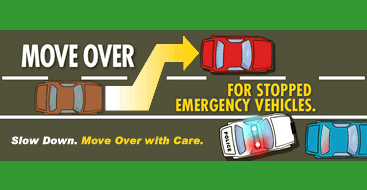
The second law requires drivers who are approaching an emergency and service vehicles stopped on the road with their emergency lights flashing to do one of two things: move out of the lane nearest the vehicle, or slow down to 20 mph below the posted speed limit (down to a minimum of 5 mph). In other words, if you're going down the freeway in the right lane and there's an emergency vehicle parked on the right shoulder ahead, you should immediately move into the next lane to the left. If you can't, or if you're on a road where there is no lane to move over to, then you must slow down to 20 mph below the posted limit. The purpose of this law is to give emergency and service workers a safe area to work in when they're on or near the road.
This law initially covered emergency vehicles but has been updated over the years to include all of the following when displaying appropriate flashing lights:
Emergency vehicles (police, fire, ambulance)
Tow trucks
TxDOT and toll road operator vehicles
Utility vehicles
Solid waste vehicles
Animal control vehicles
Parking enforcement vehicles
Emergency vehicle behind you at a red light
If you're stopped at the head of the line at a red light and an emergency vehicle with its lights flashing and siren sounding is behind you and can't get through or around the traffic, then you should first try to make room for them if at all possible by scooting over. If that is not possible, then you should consider running the red. The law does not specifically require or allow this, but the spirit of the law dictates that the right-of-way of the emergency vehicle takes priority over the traffic signals. Before you go through the red, though, make sure it is absolutely safe to do so. In most cases, cross traffic will see your predicament and stop, but if not, nudge slightly into the intersection as a signal to other drivers but wait until it is safe before you cross. Then, go through the intersection, pull over and stop. A safer alternative would be to turn right, but again, only when it is clear to do so.
§545.302. STOPPING, STANDING, OR PARKING PROHIBITED IN CERTAIN PLACES
[...]
(b) An operator may not, except momentarily to pick up or discharge a passenger, stand or park an occupied or unoccupied vehicle:
[...]
(2) within 15 feet of a fire hydrant;
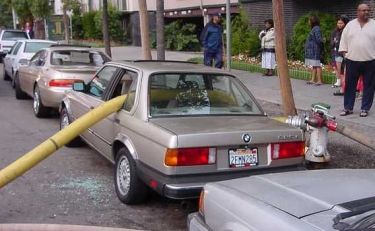
You'd think most people would have enough common sense to know not to park in front of a fire hydrant, but I see it done all the time. I think many people just aren't paying attention.
Obviously, in case of a fire, the fire department needs to be able to find and access hydrants quickly. If you're parked in front of one they need, it obstructs them and delays their response. Would you want someone blocking the fire hydrant nearest your home if it were on fire?
There's a scene in the movie Backdraft where the firefighters break the windows of a car parked in front of a hydrant and run the hose through the car — apparently, from the photo below, it happens in real life as well.
(6) "Park" or "parking" means to stand an occupied or unoccupied vehicle, other than temporarily while loading or unloading merchandise or passengers.
[...]
(9) "Stand" or "standing" means to halt an occupied or unoccupied vehicle, other than temporarily while receiving or discharging passengers.
(10) "Stop" or "stopping" means:
(A) when required, to completely cease movement; and
(B) when prohibited, to halt, including momentarily halting, an occupied or unoccupied vehicle, unless necessary to avoid conflict with other traffic or to comply with the directions of a police officer or a traffic-control sign or signal.
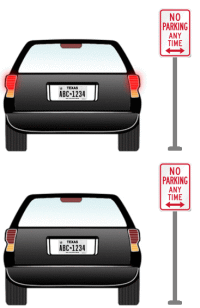
The terms "no parking", "no standing", and "no stopping" are not well-understood and often conflated.
No stopping is the most restrictive — you cannot stop there even briefly for any reason except if you have to because traffic has stopped, you need to stop to avoid hitting a pedestrian or another vehicle, or a police officer directs you to stop.
As for no parking and no standing, the difference basically boils-down to whether or not you're loading or unloading people or stuff. If you stop for a passenger to get in or out, that's standing. If you stop to load or unload cargo, that's parking.
To help summarize the differences, I've created this handy-dandy reference table that shows what's allowed and not allowed in each situation:
Loading/unloading passengers
Loading/unloading cargo
To summarize, if there's a "no parking" sign, you can only stop briefly to load or unload passengers or cargo.
If there's a "no standing" sign, you can only stop briefly for passengers to get in or out, but you cannot load or unload cargo.
If there's a "no stopping" sign, then you can't stop at all (other than as discussed above).
Here's another summarization: "no stopping" also means no standing and no parking, and "no standing" also means no parking.
It's a common belief that "standing" means the vehicle is parked but occupied, while "parking" means the vehicle is not occupied. However, this is not the case — all of the definitions above apply whether the vehicle is occupied or not. So, if you're not actively loading or unloading passengers or cargo, you can't wait in a no parking zone even if you're in the vehicle with the engine running.
When loading or unloading, it should be brief and continuous. If you're not actively loading or unloading, it's time to move on.
Other things to know about street parking
Many parking restrictions apply to the entire block on that side of the street, so be sure to check for signs up and down the street. Sometimes there will only be one sign for the whole block.
When there is free timed parking on a street, it applies to the entire block on the same side, so beware of this if you want to leave and come back later. For example, let's say you park on a street with two hour parking at 8:00 am and then leave at 9:00 am. At 8:30 am, a parking officer noted your vehicle plate and time. Then, you return at 11:00 am and park on the same side of the street in the same block but in a different space. In this scenario, you could actually be cited for overtime parking even though you left and came back and you're in a different space. The reason is because when parking officers time vehicles by recording license plates, they record the block and side of the street as the location; they don't record specific spaces. When they come back later to see who is still there, they have no way of knowing that you left and came back during the interim because you're in the same block and side of the street where they recorded you earlier. So in this case, they recorded your vehicle at 8:30 am, and when they came back at 11:15 am, your car was still parked on that same side of that same block, so it appears you were there from 8:30 am until 11:15 am, 45 minutes more than the two hours allowed. It's obviously not a perfect system, but that's how it works.
The upshot — if you leave and return within a few hours, park on the other side of the street or in a different block. (Note that this applies when time is tracked on hand-held devices using license plate numbers; it doesn't apply if they use the old-fashioned method of putting a chalk mark on your tires.)
In many places, individual parking meters have been replaced by parking kiosks located either in the middle or ends of the block, so be sure to check for this when parking, especially in a business district. If the kiosk generates a receipt, it must be placed on your dashboard with the time visible. Some systems allow you to pay by mobile phone; for these, you'll enter your license plate so the officers know who has paid.
If a parking meter is defective, you can park for free up to the maximum time shown on the meter. If there is a handwritten note or other obviously non-official indication that the meter is broken, be sure to confirm it for yourself. Ultimately, you'll be responsible for proving the meter was broken.
When parking at a single-space parking meter, you should park with your front bumper at the meter and pay that meter unless there are markings that indicate otherwise.
Sometimes, areas with meters will also have a no parking restriction during certain times such as during rush hours or for street cleaning. Most of the time, this will be indicated on the meter, but not always, so be sure to also look for signs — a "no parking" sign overrides a meter, even if you feed it.
There are many parking restrictions that don't have to have signs because you're supposed to know them if you have a driver's license. Here are the most common ones people seem to forget:
No parking or standing within 30 feet on the approach to a stop or yield sign or traffic signal
No parking or standing within 20 feet of a crosswalk (marked or unmarked) at an intersection
Parking facing the wrong direction
§545.303. ADDITIONAL PARKING REGULATIONS
(a) An operator who stops or parks on a two-way roadway shall do so with the right-hand wheels of the vehicle parallel to and within 18 inches of the right-hand curb or edge of the roadway.
(b) An operator who stops or parks on a one-way roadway shall stop or park the vehicle parallel to the curb or edge of the roadway in the direction of authorized traffic movement with the right-hand wheels within 18 inches of the right-hand curb or edge of the roadway or the left-hand wheels within 18 inches of the left-hand curb or edge of the roadway. This subsection does not apply where a local ordinance otherwise regulates stopping or parking on the one-way roadway.
When parallel parking on a street, it is illegal to park facing oncoming traffic. Lots of folks do it, though, especially in residential neighborhoods. But it's illegal because it's generally unsafe for several reasons.
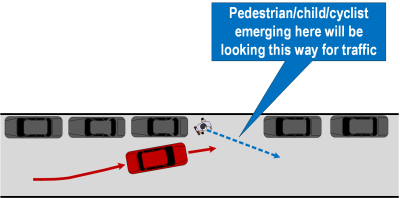
First of all, to park facing traffic requires one to drive on the wrong side of the street, which is illegal unless overtaking another vehicle or passing an obstruction. And in doing so, pedestrians, cyclists, children, or other motorists are not expecting you to be coming from that direction on that side of the street and may enter the street without looking for you.
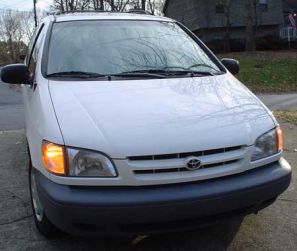
Secondly, all cars have reflectors on the rear, but the front of most cars do not have reflectors, so when parking at night, a vehicle facing the wrong way is less visible, especially in low-visibility conditions.
Also, when leaving a parking space faced the wrong way, you have to clear traffic from both directions, a more complicated task, especially from a parallel position.
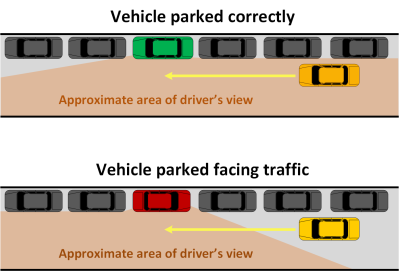
Finally, when you are parked the wrong way and another vehicle parks in front of you — especially one that is larger — your view of traffic will be obstructed since you will be seated at the curb side instead of on the traffic side. Therefore, you will not be able to see oncoming traffic until your vehicle is most of the way into the traffic lane, thus creating a hazardous condition.
Note that when parked the wrong way, you have a much more restricted view of approaching vehicles on your side of the street as highlighted by the yellow car, thus making it far more dangerous when trying to pull-out.
But, you say, you park where someone won't park in front of you. Yes, then in that case, this specific reason wouldn't apply. However, the law does not provide that exception, and for good reason, Sure, maybe there's not a place to legally park in front of you. But what if a car broke down there? Or someone parked illegally there? Not to mention that some of the other safety reasons mentioned above still apply. So take the extra 30 seconds to turn around and park facing the right way.
Using your hazard lights while parking illegally
Many people who park someplace they shouldn't in order to briefly run inside will switch on their hazard lights (flashers) to indicate that they're parking for "just a minute" and that they'll be right back. Some even believe this legalizes what they're doing.
It doesn't.
If the sign says "no parking", then that means no parking. It doesn't mean "no parking except for a minute or two" while you run into the store, restaurant, etc. If that's what they meant, then the sign would say that. Switching on your hazards doesn't magically exempt you. In fact, most parking enforcement officers say that a car with its flashers on is a beacon to them that the car is parked illegally and tells them that the driver knew they weren't supposed to park there.
This tells parking enforcement officers, "come give me a ticket!"
(a) A vehicle shall display each lighted lamp and illuminating device required by this chapter to be on the vehicle:
(1) at nighttime; and
(2) when light is insufficient or atmospheric conditions are unfavorable so that a person or vehicle on the highway is not clearly discernible at a distance of 1,000 feet ahead.
First, let's talk about the law in this situation. The law requires you to use all your lights (including headlights) at nighttime, which is defined as being one half hour after sunset to one half hour before sunrise, as well as any time when you cannot see clearly for 1,000 feet, which essentially covers all inclement weather as well as dusk and dawn. Therefore, you should never be driving with just your parking lights on because if you're in a situation where you need to have any lights on at all, then you must use all your lights, which includes your headlights.
Some people will say that they don't want to use their headlights during bad weather or at dusk because there's enough ambient light for them to see and their headlights won't be illuminating anything. However, headlights are not only for lighting-up the road ahead for you to see, but they also make you more visible to other drivers. Headlights are visible at a greater distance than parking lights alone. This is why motorcycles and emergency vehicles always use their headlights, and is also the rationale behind daytime running lamps (see the subtopic below for more discussion on DRLs). So whenever visibility is reduced, you should use your headlights, if not to help you see but to help others see you.
Others may argue that using their headlights puts a strain on their electrical system or battery. This is simply not true. Your vehicle's electrical system is designed to operate all of the vehicle's electrical devices, including the headlights. Your battery is only used to start your car and to power electrical devices in the car when the engine is not running. When your engine is running, the alternator, which is cranked by the engine, is providing power to your vehicle as well as recharging your battery. If using your headlights does indeed cause electrical problems for your car, then your car is unsafe and needs repair.
So what are parking lights for then? Their purpose is to give your car visibility while parked on a dark road but not in a situation where you would need to use your hazard flashers. Most people don't use them, so some manufacturers have eliminated them.
Parking lights vs Daytime Running Lamps
Note that parking lights are not the same as Daytime Running Lamps. Parking lights are when you can activate the front and rear marker lights without turning-on the headlights (see the photo below for an example). These are intended to make your vehicle more visible while it is parked on the side of a dark road, thus the term "parking lights". As discussed above, some manufacturers have eliminated them, but for vehicles that still have them, there is typically a third setting or position on the headlight switch — position 0 is off, position 1 is the parking lights, and position 2 is all the lights including the headlights.
Daytime running lamps are essentially the opposite of parking lights — they're the headlights illuminated with the front, rear, and side marker lights off and are generally automatically-controlled. Some vehicles use a completely separate set of lamps instead of the main headlights for the DRLs. Wikipedia has a good write-up on the differences.
Parking lights
Turn signals in turn-only lane
§545.104. SIGNALING TURNS; USE OF TURN SIGNALS
(a) An operator shall use the signal authorized by Section 545.106 to indicate an intention to turn, change lanes, or start from a parked position.
(b) An operator intending to turn a vehicle right or left shall signal continuously for not less than the last 100 feet of movement of the vehicle before the turn.
(c) An operator may not light the signals on only one side of the vehicle on a parked or disabled vehicle or use the signals as a courtesy or "do pass" signal to the operator of another vehicle approaching from the rear.
It might seem logical that if you are in a turn-only lane, you don't need to signal your turn. As you can see above, however, the law is quite straightforward — you must use a turn signal any time you want to turn or change lanes. There is no exception for turn-only lanes. The reason is simple: while it may be obvious to you and to the guy behind you that you are in a turn-only lane, it may not be evident to motorists or pedestrians across the intersection or on the intersecting road. Using your turn-signal clearly indicates to everyone who may need to know that you are are going to turn.
Some states waive the requirement to use turn signals if no other vehicles are in the vicinity, but Texas has no such exception. You don't know what you don't know, so you should always signal in case there's someone nearby you don't see.
ADVERTISEMENT
Turning from and into the correct lane
§545.101. TURNING AT INTERSECTION
(a) To make a right turn at an intersection, an operator shall make both the approach and the turn as closely as practicable to the right-hand curb or edge of the roadway.
(b) To make a left turn at an intersection, an operator shall:
(1) approach the intersection in the extreme left-hand lane lawfully available to a vehicle moving in the direction of the vehicle; and
(2) after entering the intersection, turn left, leaving the intersection so as to arrive in a lane lawfully available to traffic moving in the direction of the vehicle on the roadway being entered.
(c) On a street or roadway designated for two-way traffic, the operator turning left shall, to the extent practicable, turn in the portion of the intersection to the left of the center of the intersection.
(d) To turn left, an operator who is approaching an intersection having a roadway designated for one-way traffic and for which signs are posted from a roadway designated for one-way traffic and for which signs are posted shall make the turn as closely as practicable to the left-hand curb or edge of the roadway.
(e) The Texas Transportation Commission or a local authority, with respect to a highway in its jurisdiction, may:
(1) authorize the placement of an official traffic-control device in or adjacent to an intersection; and
(2) require a course different from that specified in this section for movement by vehicles turning at an intersection.
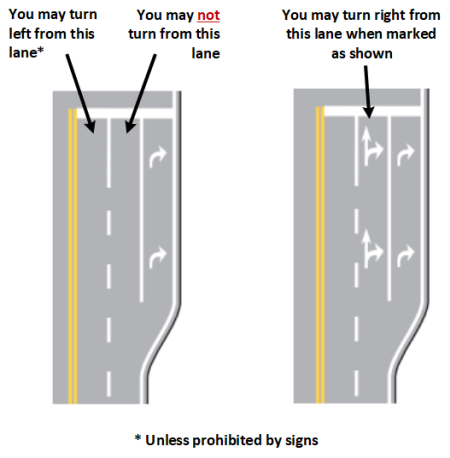
Imagine you are on a street approaching an intersection with lanes marked like the right hand illustration above. Recently, I have seen an increasing number of people turn from the two center lanes.
BUZZ!
Unless there are signs and/or lane markings indicating otherwise, the law only allows you to turn left from the far left lane or to turn right from the far right lane. When there are dedicated turn lanes like those in the right hand example above, those lanes fulfill those roles. So, for example, if you wanted to turn right from the right hand through lane (i.e. the lane immediately to the left of the right-only lane), you would only be permitted to do so if it was marked as shown in the illustration at the right below.
Okay, now that we know which lane to turn from, we need to know which lanes we can legally turn into. In Texas, when turning right, you are required to turn both from the right lane (as discussed above) and into the right lane unless there is an obvious safety reason not to (e.g. you're driving a long vehicle, or there is a pedestrian or debris in the road) or, of course, if there are signs are markings indicating otherwise (such as a double turn lane).
When turning left, however, you are permitted to turn into any lane designated for traffic headed in that direction, and it is recommended that you pick the lane that interferes least with other traffic. That said, good driving habits dictate that you turn into the lane nearest you so as to be predicable. So, if you're turning left, you should turn into the left lane if possible. And, if you're turning left from a one-way street onto another one-way street, you are required to turn into the left lane (i.e. the mirror image of a right turn).
Turning from a double turn lane
If you are turning from one of two lanes designated for the same turn movement (i.e. double turn lanes), then you must turn into the appropriate lane as indicated by signs and/or pavement markings.
Center left-turn lanes
§545.060. DRIVING ON ROADWAY LANED FOR TRAFFIC
[...]
(b) If a roadway is divided into three lanes and provides for two-way movement of traffic, an operator on the roadway may not drive in the center lane except:
(1) if passing another vehicle and the center lane is clear of traffic within a safe distance;
(2) in preparing to make a left turn; or
(3) where the center lane is designated by an official traffic-control device for movement in the direction in which the operator is moving.
As you can see above, the law for the use of center two-way left-turn lanes is pretty much non-existent. The statute above is the only one that pertains to center lanes, and other than allowing its use for left turns, it doesn't give any restrictions on how it can used for that purpose.
Before we move on, now would be a good time to point-out that while section (b)(1) above says you can use a center lane for passing, keep in mind that center lanes marked as left-turn lanes cannot be used for passing as the traffic signs and pavement markings take precedence. Section (b)(1) really is an artifact from days long ago where so-called "suicide lanes" were used on rural roads to allow passing in either direction; fortunately, those lanes are pretty much all gone now and have been replaced by dedicated passing lanes for one direction or the other. Section (b)(3) then applies in that case or also in the case of reversible lanes.
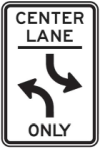
Regarding center two-way left-turn lanes (TWLTL), if the law doesn't specify how it is to be used, then where is that defined? For starters, the Texas DPS driver handbook states, "the only time a vehicle should enter the center (turn) lane is at a point where the vehicle will have time to slow down or stop in order to make a safe left turn maneuver. The center turn lane should never be used for passing or as a through traffic lane." That explanation is based on the Texas Manual on Uniform Traffic Control Devices (TMUTCD), which as mentioned elsewhere on this page has statutory authority for the definition of signs and markings. The TMUTCD states that a lane marked with the sign at the left and the standard TWLTL markings (a solid yellow line with a broken yellow line to the inside) "is reserved for the exclusive use of left-turning vehicles in either direction and is not used for passing, overtaking, or through travel."
So with that said, there are many questions that arise that are not directly answered by the statute or TMUTCD. Probably the top one is, how far before turning can you legally enter this lane? Again, there is no defined statutory limit. Furthermore, each situation is different and can vary depending on the speed of the vehicle, weather and traffic conditions, the presence of an oncoming vehicle in the lane, etc. Drivers must use their best judgment and not enter the lane too early or they may be perceived as using it as a through or passing lane. Police officers also have to use their judgment in enforcement, and this difference in what may be considered "too far" often results in a citation. The general guidance is to not enter the lane until just before you need to slow down to either stop or complete your turn. This will vary depending on your speed and the presence of other vehicles int the TWLTL.
Using the center turn lane to pass other vehicles or stopped traffic
Another common question is whether you may use a TWLTL in order to pass traffic stopped in the through lanes if you want to turn left at a downstream intersection. Again, the law does not address this maneuver. If you use it to pass the stopped traffic for a relatively short distance during which you're decelerating, then this would generally be an accepted use of the lane and you're not likely to get cited. But you could be cited if you pass a long line of vehicles or no vehicles while not decelerating, pass vehicles that aren't stopped, continue past other locations where you could turn left without turning, or if your action interferes with someone wanting to make an opposing left turn.
Using the center turn lane when turning from side street or driveway
Finally, one other common question is whether you can use the TWLTL to wait or merge when turning onto the main road from a side street or driveway. Once again, the law and TMUTCD gives us no guidance on this. However, the Federal Highway Administration's Read Your Road guide, which humorously calls the TWLTL a "special place", states that, when turning from a side street or driveway onto the main road, you may use this lane as "a safe mid-point to wait for a gap in traffic approaching from the right before completing your turn." Therefore, it would be considered reasonable that is an accepted use of the lane, and I'm told DPS officers are instructed to allow this use. Still, it is important to note that Texas law makes no provision for this action, either prohibiting it or allowing it, and since the signage and markings indicate it is a left-turn lane from the main road, any other use would technically not conform to that. As a result, I have had reports that drivers have been cited for doing this and a judge has subsequently upheld the violation. Therefore, I would recommend avoiding this maneuver unless absolutely necessary and, if you do, do not under any circumstances use the center turn lane as an acceleration lane! Instead, stop immediately after entering the lane and wait until there is an opening in the traffic, then move immediately and carefully from the center lane into the through lane.
One final note: Be aware that some other states, as well as some municipalities in Texas, have laws that more specifically regulate the use of TWLTLs. For instance, the City of Cleburne specifically states a TWLTL can only be used by drivers when preparing to turn from said lane, and you're not allowed to drive in a TWLTL for more than 200 feet.
Using the center left turn lane to turn from a side street or driveway - not allowed (violation)
This use of the center turn lane would be considered a violation since the lane is not designated for use as an acceleration lane.
Using the center left turn lane to turn from a side street or driveway - acceptable
This use of the center turn lane would likely be considered acceptable since the driver enters the lane and waits to avoid conflicting with other traffic before merging.
Roundabouts
While at one point roundabouts were novel, most drivers nowadays are familiar with them as their use grows around the state. Still, it seems many drivers are intimidated by them or otherwise still don't quite understand the rules for using them. So here are some tips for navigating a roundabout.
Entering a roundabout
Reduce speed and start looking for traffic from your left as you approach. If nobody is already in the roundabout immediately to your left, and there are no pedestrians trying to cross, then you can enter the roundabout without stopping. If someone is approaching the roundabout on your left but has not already entered it, you don't need to wait for them — you have plenty of time to enter the roundabout and move on before they're in a position to be a hazard to you or vice-versa.
You do not need to signal when entering a roundabout and should not do so unless you will be taking the first exit out of the roundabout. Otherwise, a driver approaching from the right may think you are signaling to leave the roundabout and could enter without stopping, thus possibly causing a collision.
While in a roundabout
Once in a roundabout, keep moving — do not try to be "helpful" by stopping to let someone enter the roundabout. Doing so is the equivalent of stopping at a green light; drivers behind you won't expect it and may rear-end you, not to mention that stopping unnecessarily gums-up the works.
Leaving a roundabout
To leave a roundabout, watch for your exit. Just before you exit, signal right. Then carefully veer right to leave the roundabout keeping an eye out for any pedestrians that may be crossing or preparing to do so.
If you miss your exit, just go around again.
Roundabout vs. traffic circle
While some people use the terms interchangeably, a roundabout and a traffic circle are technically two different things. A traffic circle is larger than a roundabout and may have different right-of-way control at each entrance, including possibly traffic signals.
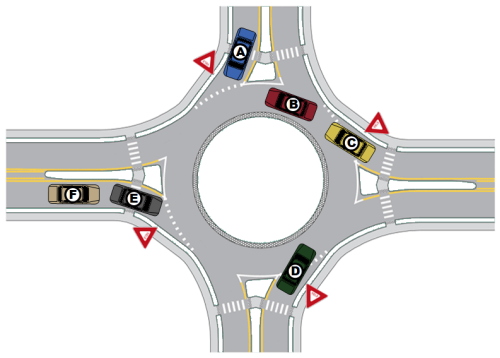
Roundabout tips
A: This driver is yielding properly. If they enter now, they could cause a collision. B: This driver should continue moving and not stop to let driver A enter the roundabout. C: This driver is entering properly as there is nobody nearby to yield to. D: This driver is also entering properly as there is nobody nearby to yield to. E: This driver is stopping unnecessarily because they incorrectly believe they have to stop if a vehicle is anywhere in the roundabout or even just getting ready to enter it. F: This driver is pretty annoyed with the driver of vehicle E and nearly rear-ended them because driver E stopped unexpectedly and unnecessarily.
Turning left across a median
Boy, this seems to be a never-ending hot topic of debate, especially in the Houston area for some reason: What is the proper way to turn left across a median? Specifically, do you keep to the near side when turning, or do you continue over to the far side before turning?
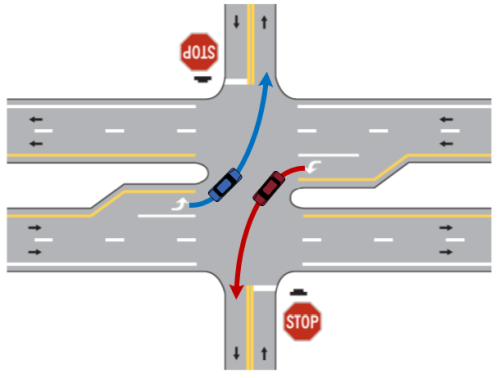
The answer? You probably won't like it: It depends! More specifically, it depends on the width of the median.
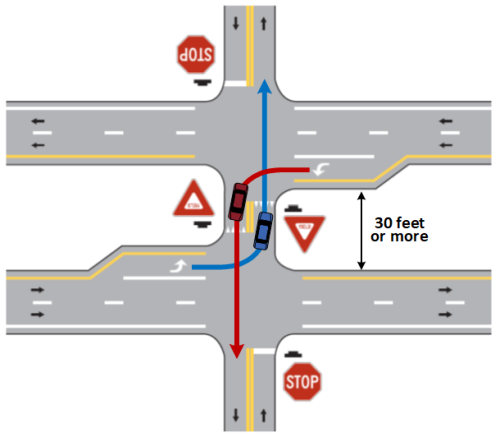
In Texas (and many other states), if the median is 30 feet or more wide (nominally), then the junctions on each side of the median are legally considered to be separate intersections (§541.303; see statute below). This then means that the crossover through the median is considered to be a tiny little road all by itself. Even though it's short, you still have to treat it as if it were any other road; that is, you must drive on the right side of it, just like you would do turning onto any other road. These are considered to be "wide medians".
How to turn left when a median is 30 feet wide or wider ("wide median")
Note the yield signs and markings in the crossover.
If the median is less than 30 feet wide, then the whole thing is considered one big intersection, so you would make a "regular" left turn just as you would if there was no median; that is, pass opposing left-turning traffic on your passenger side. These are considered to be "narrow medians".
How to turn left when a median is less than 30 feet wide ("narrow median")
Note the lack of signs and markings in the crossover.
So how do you tell how wide a median is? Obviously, nobody expects you to get out and measure it. So to help, there are clues:
If a median is 30 feet wide or more, there will usually be yield or stop signs in the median, a set of double-yellow lines, and stop or yield lines; these are your cues to treat it as a wide
median (top example above).
If there are no stop or yield signs or lane markings in the median, then that is generally your cue to treat it like a narrow
median (bottom example above). In these cases, there is often (but not always) a "keep right" sign on the median nose.
Signalized intersections should usually be treated as a narrow median regardless of width.
As a footnote, the width of the median is determined by the distance between the inner yellow line on each side, not the physical median itself. So this would include the inside shoulder if there is one.
How to handle ambiguous cases
Regrettably, there are quite a few locations where medians wider than 30 feet are not signed as shown above — this invariably causes confusion and conflict among drivers who may interpret the intersection differently. In those cases, you'll have to do a quick assessment to determine the best way to turn. If the crossover space appears wide enough for a standard passenger vehicle to stop perpendicular to the main road (or nearly so) and not interfere with passing traffic, then the median is probably wide enough to be considered a wide median and you should turn according to the top example above. If not, then treat it as a narrow median. If other vehicles are already in the median when you approach, that can help you evaluate its width; if not, you'll have to use your best judgment.
If other drivers are already in the median and are "doing it wrong", they will likely make it difficult or impossible for you to "do it right"; in that case, it might be safer to wait for them to complete their turn before you move into the median, after which other drivers will hopefully follow your lead.
There are also a few places where medians are signed as if they were wider than 30 feet when, in fact, they're not. In those cases, you should still follow the signs and markings and treat it as a wide median.
By the way, the same rules above apply if you're making a U‑turn.
No, those triangles don't tell you which way to drive
In many such crossovers, there is a row of triangle markings across each side of the median like shown below.
"Sharks teeth" yield lines in median
These do NOT indicate which way you're supposed to drive in the median.
Some drivers have interpreted these to be arrows indicating which direction they should drive. However, these are not arrows; they are what are known as "shark's teeth" and they form a yield line reminding drivers crossing the median to yield. Their triangular shape is meant to depict a yield sign, which usually is also present. So when approaching them, the point should be facing you.
Another big clue are the double yellow lines — you always drive to the right of double yellow lines.
Yield line
Snippet from the Manual on Uniform Traffic Control Devices establishing that these triangular markings form a yield line. Note the indicated direction of travel.
Legal basis
Since this topic often elicits fisticuffs arguments on social media, and some obstinate clods out there stubbornly don't want to believe me, here is some supporting documentation to back me up. First of all, here's the statute that defines the 30-foot rule:
§541.303. INTERSECTION
[...]
(c) Each junction of each roadway of a highway that includes two roadways at least 30 feet apart with the roadway of an intersecting highway, including each roadway of an intersecting highway that includes two roadways at least 30 feet apart, is a separate intersection.
This is a good example of a confusingly-worded statute, so here it is paraphrased: On a divided highway where the roadways are 30 feet apart, each junction on each side where it intersects another roadway are considered separate intersections. If two divided highways cross each other and both of them have roadways 30 feet apart, then all the places where they cross are separate intersections.
Finally, if you need an "official" interpretation that confirms what I've stated above (seriously, you still don't believe me?), see the "Divided Highway Intersections and Crossovers" section of TxDOT's Sign Crew Field Book.
Cutting through private property or over medians
§545.423. CROSSING PROPERTY
(a) An operator may not cross a sidewalk or drive through a driveway, parking lot, or business or residential entrance without stopping the vehicle.
(b) An operator may not cross or drive in or on a sidewalk, driveway, parking lot, or business or residential entrance at an intersection to turn right or left from one highway to another highway.
§545.063. DRIVING ON DIVIDED HIGHWAY
(a) On a highway having two or more roadways separated by a space, physical barrier, or clearly indicated dividing section constructed to impede vehicular traffic, an operator shall drive on the right roadway unless directed or permitted to use another roadway by an official traffic-control device or police officer.
(b) An operator may not drive over, across, or in a dividing space, physical barrier, or section constructed to impede vehicular traffic except:
(1) through an opening in the physical barrier or dividing section or space; or
(2) at a crossover or intersection established by a public authority.
§545.064. RESTRICTED ACCESS
An operator may not drive on or from a limited-access or controlled-access roadway except at an entrance or exit that is established by a public authority.
It is illegal to drive through private property for the purpose of turning left or right from one road to another. In other words, it's illegal to cut-through that gas station or drug store on the corner so you don't have to stop at the stop sign or red light or to avoid the line of cars waiting at the intersection.
Cutting through the corner property is illegal
Even if you stop, this is a violation.
It is also illegal to drive across any median. This includes the median between the freeway and the frontage road — yes, even when there's a traffic jam on the freeway. If you want to get onto the frontage road, get off at the next exit. Crossing medians is rife with hazards to you, your vehicle, the road and grass, and other drivers, and you frequently won't gain much advantage anyway.
Example of a "Texit" on I-35
Crossing here is illegal.
(Photo source: Google Maps)
Also be sure to see the section about "flush median islands" in the lane markings section above.
Yielding on frontage roads
§545.154. VEHICLE ENTERING OR LEAVING LIMITED-ACCESS OR CONTROLLED-ACCESS HIGHWAY
An operator on an access or feeder road of a limited-access or controlled-access highway shall yield the right-of-way to a vehicle entering or about to enter the access or feeder road from the highway or leaving or about to leave the access or feeder road to enter the highway.
This law is pretty straightforward as written: if you're on the frontage road (a.k.a. access road, feeder road, service road, or gateway) of a freeway or expressway, then you must yield to traffic exiting the freeway or expressway and coming onto the frontage road. That said, there are some nuances that will be discussed below.
Note that yielding may or may not mean stopping (see "Yield vs. stop" below).
On all frontage roads, you must yield to traffic leaving the freeway as they are entering the frontage road. In areas with two-way frontage roads, you must also yield to (oncoming) traffic that is entering or about to turn onto an entrance ramp. In those areas, drivers who are not getting on the freeway will often use their right turn signal as a friendly gesture so that oncoming traffic will know they don't have to slow down or stop for them (see diagram below). If you see this, though, be extra careful as the person may have left their turn signal on from a previous turn and actually wants to enter the freeway. Also, keep an eye out for traffic behind them who may want to enter the freeway.
So a question that may come to mind is, how far after someone exits the freeway am I required to yield to them? On a two-way frontage road, the location of the intersection(s) is generally quite obvious, and so the yield applies there. On a one-way frontage road, however, the angle of the ramp makes it a little more difficult to delineate when traffic is no longer "entering" the frontage road. One way of looking at it is that the yield requirement covers the intersection of the two roadways, which is defined in §541.202 as "the place where vehicles could collide if traveling on roadways of intersecting highways that join at any angle other than an approximate right angle." The diagram below illustrates this.
Potential collision points at intersection of one-way frontage road and exit ramp
The potential collision points indicate the location of the intersection of the ramp and frontage road as defined by law and, thus, the extent of where frontage road traffic is required to yield to exiting traffic.
But perhaps an easier interpretation is that once a driver exiting the freeway turns into a lane on the frontage road, they then become established in that lane and are thus no longer entering the frontage road, so the requirement to yield to them ends at that point. Moving from that lane then becomes an ordinary lane change and is instead subject to the laws that govern lane changes.
Another question is, can traffic exiting the freeway shoot across the frontage road and immediately turn into a driveway? As long as there isn't a double white line (more on that below), then yes, it is technically legal, although strongly discouraged due to the myriad of hazards it causes.
It's worth noting that DPS' interpretation of the above situation has evolved recently. In the absence of yield signs, DPS advises that only the green car would be required to yield and that if the blue car collided with the red car, the cause would be that the blue car made an unsafe lane change. That said, it is this author's opinion that the law is not clear in this situation and that the best course of action would be for both the green and red cars to always yield to the blue car.
The double white line exception
The law cited above covers all entrance and exit ramps, even if there are no yield signs. However, there is an unwritten exception: When traffic exiting the freeway has its own added lane that is separated from the other frontage road lanes with a double white line, then no yield is required. This is because the double white line forces exiting vehicles into their own lane on the frontage road and to travel in that lane beyond the intersection of the ramp and frontage road. As discussed above, this means when they reach the point at which they can legally move into the other frontage road lanes, it's just an ordinary lane change at that point and is regulated accordingly (see diagram below). This configuration was developed to alleviate the congestion on many urban frontage roads that occurred as a result of frontage road traffic having to yield to a nearly continuous stream of exiting vehicles. Eliminating the need for traffic on the frontage road to yield improves traffic flow. This configuration also improves safety because it eliminates the hazards caused by injecting exiting traffic directly into or across the frontage road traffic and helps exiting drivers to adjust to frontage road conditions before moving over. As a result, this configuration is becoming more widespread.
One-way frontage road with double-white line creating added lane for exiting traffic
Since exiting traffic is required to use the added lane, through-traffic on the frontage road is not required to yield.
Some people write me to ask for the statute where this exception is granted — well, as I mentioned above, this is an unwritten exception. Instead, the "exception" in this case is the logical outcome of the combination of the added lane, double white lines, and the resultant traffic flow. The double white line means that exiting traffic cannot legally conflict with traffic already on the frontage road at the point where the ramp and frontage road intersect. Instead, the double white line forces that exiting traffic into a lane and past the point where they would conflict with traffic already on the frontage road. As a result, there is no intersecting traffic that would require right-of-way control like there is at locations that don't use this configuration, and thus the statute above no longer applies.
Note that there must be a double white line for the exception above to apply. If the exiting traffic has its own lane, but that lane is separated from the others by a single solid white line or a broken white line, then the yield law still applies. This is because in that situation, the exiting traffic is not required to enter the added lane and could immediately cross into any of the other frontage road lanes (see diagram below). These potential conflicts have resulted in this configuration being deprecated by TxDOT. See the lane markings section above for clarification on why someone can cross a single solid white line.
Yield required on frontage road when exiting traffic has its own lane NOT separated by a double-white line
Since there is an added lane for exiting traffic, there often won't actually be a yield sign like is shown here; however, you are still required to yield in this situation since vehicles can still legally make the maneuver shown above and could therefore collide with through traffic on the frontage road.
Many locations with a double white line also have signs like the one shown to the right here. However, these signs are considered reminders and are not required as the double white lines alone convey the "do not cross" meaning. Also note that traffic already on the frontage is not allowed to cross left over the double-white lines.
Finally, you may happen upon a location with a yield sign and double white lines. In these situations, the yield sign is usually an artifact from a previous configuration before the double white line was added and, due to an oversight, the yield sign was not removed.
Official support
If you desire an "official" confirmation of this interpretation, see the "Frontage Road-Ramp Intersection Control" section of TxDOT's Sign Guidelines and Applications Manual.
Yield vs. stop
§544.010. STOP SIGNS AND YIELD SIGNS
(a) Unless directed to proceed by a police officer or traffic-control signal, the operator of a vehicle or streetcar approaching an intersection with a stop sign shall stop as provided by Subsection (c).
(b) If safety requires, the operator of a vehicle approaching a yield sign shall stop as provided by Subsection (c).
(c) An operator required to stop by this section shall stop before entering the crosswalk on the near side of the intersection. In the absence of a crosswalk, the operator shall stop at a clearly marked stop line. In the absence of a stop line, the operator shall stop at the place nearest the intersecting roadway where the operator has a view of approaching traffic on the intersecting roadway.
§545.153. VEHICLE ENTERING STOP OR YIELD INTERSECTION
(a) Preferential right-of-way at an intersection may be indicated by a stop sign or yield sign as authorized in Section 544.003.
(b) Unless directed to proceed by a police officer or official traffic-control device, an operator approaching an intersection on a roadway controlled by a stop sign, after stopping as required by Section 544.010, shall yield the right-of-way to a vehicle that has entered the intersection from another highway or that is approaching so closely as to be an immediate hazard to the operator's movement in or across the intersection.
(c) An operator approaching an intersection on a roadway controlled by a yield sign shall:
(1) slow to a speed that is reasonable under the existing conditions; and
(2) yield the right-of-way to a vehicle in the intersection or approaching on another highway so closely as to be an immediate hazard to the operator's movement in or across the intersection.
(d) If an operator is required by Subsection (c) to yield and is involved in a collision with a vehicle in an intersection after the operator drove past a yield sign without stopping, the collision is prima facie evidence that the operator failed to yield the right-of-way.
There's a reason for having two different signs. "Stop" means that you must come to a complete stop, period. "Yield", however, doesn't always mean that you have to stop. Instead, a yield sign means that you must give the right-of-way to other traffic by slowing or stopping as necessary. You can often satisfy the requirement to yield by slowing down enough to let the other guy get through the intersection without any angst. But if you can clearly see nobody is coming, then you can proceed through without slowing excessively or stopping. So, if you're approaching a yield sign, start looking early and, if the way is clear, just keep going.
That said, you are indeed required to stop at a yield sign if it is necessary to provide a clear path for the other driver.
Editorial
Unfortunately, in many areas, it often seems that yield signs are placed where there should be stop signs and vice-versa. Europe overwhelmingly prefers yield signs; the US is ridiculously riddled with unnecessary stop signs.
A lot of people might be surprised, but there is no specific state law in Texas regarding who goes first at an all-way stop. The only applicable law states that drivers must stop and then may enter the intersection only when it is safe to do so (§545.153, which is quoted in the previous section above, and §545.151, which basically states the same). So that leaves the right-of-way assignment up to the drivers.
To that end, there is a widely-accepted convention that most drivers use to remove the guesswork. Basically, it's "first come, first served." Implementing it is easy: when you stop at an all-way stop, look around and see who's already stopped. When they've all gone, it's your turn! If two or more people get there at the same time at a right angle to each other, then the protocol is that the person on the right should go first. If two vehicles on opposite sides of the intersection arrive at the same time, here are the rules:
If both are going straight, they both can go at the same time.
If one is turning right and one is going straight, they both can go at the same time.
If one is turning left and one is going straight, the person going straight goes first.
If one is turning right and one is turning left, the person turning right goes first.
Be aware, however, that other states do have this codified in their traffic laws, and some cities in Texas do as well.
Sometimes you can cut the line
There are times when a driver doesn't necessarily have to wait for their turn based on arrival order. For instance, if you're the last to arrive at an intersection with cars already stopped on the other three approaches and you want to turn right, you could go immediately if the driver on your right starts to turn left (see diagram below), or if the driver across from you goes straight, since those movements don't conflict with yours and would provide "cover" for you to make your turn.
All-way stop preemption scenario
This is one scenario where a vehicle can go out-of-turn at an four-way stop. The numbers indicate the order of arrival. In this case, the driver of the green car (#4) could go at the same time as vehicle #1, despite vehicles #2 and #3 arriving first and also wanting to continue onto the same street. This is because vehicle #1's path will briefly block the other vehicles from proceeding, providing sufficient time for #4 to turn before they would conflict with the others.
ADVERTISEMENT
Don't back up on the freeway
§545.415. BACKING A VEHICLE
(b) An operator may not back the vehicle on a shoulder or roadway of a limited-access or controlled-access highway.
This one is straightforward — never, ever back up on the freeway, even on the shoulder! Besides being illegal, this is extremely dangerous! Traffic is coming toward you at high speed, and if you're backing up, you're essentially going the wrong way and risk the equivalent of a head-on collision.
If you miss your exit, just drive to the next exit, turn around, and go back. In most cases, you'll only lose a couple of minutes. Next time, make sure you know where you're going and pay attention to the signs.
Move minor crashes out of traffic
§550.022. ACCIDENT INVOLVING DAMAGE TO VEHICLE
(a) Except as provided by Subsection (b), the operator of a vehicle involved in an accident resulting only in damage to a vehicle that is driven or attended by a person shall:
(1) immediately stop the vehicle at the scene of the accident or as close as possible to the scene of the accident without obstructing traffic more than is necessary;
[...]
(b) If an accident occurs on a main lane, ramp, shoulder, median, or adjacent area of a freeway in a metropolitan area and each vehicle involved can be normally and safely driven, each operator shall move the operator's vehicle as soon as possible to a designated accident investigation site, if available, a location on the frontage road, the nearest suitable cross street, or other suitable location to complete the requirements of Section 550.023 and minimize interference with freeway traffic.
[...]
(d) In this section, a vehicle can be normally and safely driven only if the vehicle:
(1) does not require towing; and
(2) can be operated under its own power and in its usual manner, without additional damage or hazard to the vehicle, other traffic, or the roadway.
Have you ever been caught in a traffic jam only to find that it was caused by a minor fender-bender blocking a lane and everyone is standing around waiting for the police? Maybe you've thought to yourself, "there oughta be a law..."
Well, there is.
Texas law requires that anyone involved in an crash not obstruct traffic any more than is necessary. The law even specifically requires that, if an collision occurs on a freeway or freeway ramp in a metropolitan area and all involved vehicles can be safely driven, the motorists involved must move their vehicles off of the freeway immediately. This is to help prevent a traffic hazard and resulting congestion which, besides unnecessarily delaying others, also increases the likelihood of other accidents.
Many people think that their insurance won't cover them if they move their cars from the scene before the police arrive, but this is absolutely false. The police and insurance adjusters can usually determine what happened based on the stories of those involved and the damage to the vehicles. Besides, in the case of most fender-benders, you legally don't even need to have the police come to the scene. But if you want to be sure, then quickly snap some photos of the scene and vehicles before you move them out of the way.
Driving on the shoulder
§545.058. DRIVING ON IMPROVED SHOULDER
(a) An operator may drive on an improved shoulder to the right of the main traveled portion of a roadway if that operation is necessary and may be done safely, but only:
(1) to stop, stand, or park;
(2) to accelerate before entering the main traveled lane of traffic;
(3) to decelerate before making a right turn;
(4) to pass another vehicle that is slowing or stopped on the main traveled portion of the highway, disabled, or preparing to make a left turn;
(5) to allow another vehicle traveling faster to pass;
(6) as permitted or required by an official traffic control device; or
(7) to avoid a collision
A common question I get, especially for newcomers to Texas, is whether it is legal to drive on the shoulder of a two-lane highway to allow other cars to pass as they may have seen other people doing. The answer is yes, it is, as declared in (a)(5) above. You'll find that many long-time Texans will automatically move onto the shoulder when a faster car comes up behind them on a two-lane road. It's just a common courtesy that helps the other person to pass them safely and stress-free. However, there are some requirements to do this — the shoulder must be wide enough and free of debris or stalled or parked vehicles.
If you do move onto the shoulder to allow someone to pass, reduce your speed a bit, keep a sharp eye out for any obstructions ahead, and move back into the main through lane as soon as it is safe to do so.
You are also allowed to briefly drive on the shoulder to pass a vehicle that is slowing or has stopped in the main lane to turn left or has stalled. Additionally, you can also drive on the shoulder to slow down to turn right, to speed up after turning onto the highway or after having stopped on the shoulder, or to avoid a collision (duh).
You are NOT allowed to drive on the shoulder to overtake another moving vehicle (except as provided above). In other words, if the vehicle you are following will not move onto the shoulder to allow you to pass, then you must pass them on the left when it's legal and safe to do so.
Using the shoulder to bypass stopped traffic to turn right
Perhaps an even more frequent question is about using the shoulder to pass a line of stopped traffic if you want to turn right at a driveway or the next intersection. Section (a)(4) above, on its face, does seem to allow for this. However, there is major sticking point in its use of the term "to pass". The Transportation Code (§545.001) defines "pass" to mean "to overtake and proceed past another vehicle moving in the same direction as the passing vehicle and return to the original lane of travel". If you turn right, you do not return to the original lane of travel. So, (a)(4) would not apply.
That said, you can still use the shoulder to turn right using the exception (a)(3). To do so, you must enter the shoulder at the point where you would begin to decelerate for the right turn and then begin to slow down. As long as you continue to decelerate, you meet the requirement of (a)(3).
One important stipulation is that the maneuver be done "safely." Again, the law does not define this specifically, so it's open to interpretation. Typically, if there is no collision, then that could be considered prima facie evidence that it was done safely. However, a more affirmative approach would be drive slowly and make sure to use your turn signal continuously.
One question that arises when discussing this situation and the statute is the phrase "if that operation is necessary". The statute doesn't define what "necessary" is, leading some to assert that it's not "necessary" to pass the traffic and turn right. However, there is case law that addresses this specifically. In Lothrop v. The State of Texas (2012), the Texas Court of Criminal Appeals ruled that "necessary" had to be taken in the context of accomplishing the seven defined permissible reasons to drive on the shoulder. In other words, if you want to pass a vehicle stopped in the main travel lane and you have to drive on the shoulder to do so, then that is deemed "necessary" per the statute.
Many officers I've spoken with tell me that because of the uncertainty of this law, they usually won't cite for this, or they will only cite someone who does this egregiously — for example, someone who is traveling at high speed down the shoulder (which can be justified as violating the "be done safely" stipulation as discussed above). But some officers and departments will always cite for this and leave it to a judge to decide.
In short, while the approach I describe above is supported by statute and case law, this can be a bit of a gray area in some jurisdictions, so proceed carefully.
Using the shoulder to turn right - not allowed (violation)
This use of the shoulder to make a right turn would likely be considered a violation as this much distance is not necessary to decelerate before turning.
Using the shoulder to turn right - acceptable
This use of the shoulder to make a right turn would likely be considered acceptable since the driver enters the shoulder and begins to decelerate continuously before turning.
U‑turns
§545.102. TURNING ON CURVE OR CREST OF GRADE
An operator may not turn the vehicle to move in the opposite direction when approaching a curve or the crest of a grade if the vehicle is not visible to the operator of another vehicle approaching from either direction within 500 feet
The statute above is the only state law specifically regarding U‑turns, and it prohibits a U‑turn if you are not visible within 500 feet of approaching traffic. Otherwise, U‑turns are allowed anywhere as long as there is not a sign or local ordinance prohibiting it. However, many municipalities have ordinances limiting U‑turns in specific areas, such as in business districts or at signalized intersections, and these restrictions may not be not signed (although they should be). Check with your local police or traffic engineering department to see if there are any such ordinances in your city.
If you want to make a U‑turn at a traffic light, you cannot do so unless you have a green signal or flashing yellow arrow (note that the 500 foot rule above still technically applies). Whenever you make a U‑turn, you must, of course, yield to oncoming traffic just as if you were making a left turn. If you make a U‑turn with a green signal, anyone wanting to make a right-on-red from your left is usually required to yield to you, but keep in mind that they may not realize you're making a U‑turn until they've started making their turn, so be prepared to yield to them. In some cases, you are required to yield to those right turners; those cases are marked with a sign like the one shown to the right.
Don't stop on entrance ramps
Unless traffic on the freeway is completely stopped, or you can't merge and there is no place else for you to go, do not ever stop on a freeway entrance ramp! This is an extremely serious traffic hazard. Drivers behind you are speeding-up to get up to freeway speed and are looking back up the freeway for a gap to merge into. They are not expecting you to stop! If you can't squeeze into traffic by the time you get to the end of the ramp, make sure your left turn signal is on and carefully continue on the shoulder (if it's clear) until you can safely merge into the traffic stream.
Be helpful to traffic entering the freeway
If you're in the right lane of a freeway and see traffic preparing to merge, move over to the left to give them some room or, if you can't, then adjust your speed to make a gap for them to merge into. Although the law requires traffic entering the freeway to yield (basic right-of-way law, §545.151), good drivers make the effort to help-out other motorists.
Merging from the shoulder
If you stop on the shoulder to change a flat tire or deal with some other emergency and you're ready to get back on the freeway, get up to speed on the shoulder, then signal left and merge into traffic. Do not pull from a standing stop directly onto the freeway's main lanes. This very action killed a mother and van full of children west of Ft. Worth back in the mid '90s.
Drive right, pass left
§545.051. DRIVING ON RIGHT SIDE OF ROADWAY
[...]
(b) An operator of a vehicle on a roadway moving more slowly than the normal speed of other vehicles at the time and place under the existing conditions shall drive in the right-hand lane available for vehicles, or as close as practicable to the right-hand curb or edge of the roadway, unless the operator is:
(1) passing another vehicle; or
(2) preparing for a left turn at an intersection or into a private road or driveway.
Before I explain this one, let me ask you this: where is the fastest water in a river? In the middle, of course. Why? Because that is the place with the least friction. That is the deepest part of the river, and there are no ragged edges or shallow bottom to slow the water. A highway conceptually works the same way (think of it as a two-way river). The right lane has the most "friction": entering and exiting traffic, stalled vehicles on the shoulder, etc. The left lane has virtually no friction. That is why it is reserved for faster-moving traffic.
Imagine this scenario: you're in the left lane on a two-lane freeway going faster than other traffic and you come up behind someone going a little slower than you. Instead of waiting a few seconds for them to move over, you whip around them on the right. At the same time, someone going much slower than you is trying to get on the freeway at the same location. Now, both of you are creating a big hazard for each other and someone is going to have to make a quick last minute adjustment to avoid a collision. This is why (a) you shouldn't pass on the right; and (b) you should move to the right if you're traveling slower than other vehicles.
The second part of that last sentence applies no matter how fast you are going. Notice that the law only says that traffic moving "more slowly" than other vehicles; there is no exception given for vehicles traveling the posted speed limit. I know that logically and legally, if you're going the speed limit in the left lane, nobody should need to pass you. But if someone behind you wants to go faster, just move over. You're actually violating the law by not moving over because you're now the root cause of a traffic hazard. Plus, you never know — that person may have a bona fide emergency, or maybe just needs to get to a restroom in a hurry! So be kind, move over, and let 'em get on their way.
On the other hand, if you're the one behind the slower driver, have a little patience and give them a few seconds to realize you're there and to move over before you zip around them. I can't count the number of times I've seen someone in the left lane who wanted to move over but got trapped there because everyone immediately passed them on the right. Plus, the weaving of drivers who are constantly passing other vehicles causes hazards, and the turbulence caused by those frequent lane changes can be the impetus of "phantom" congestion.
Signs to remind slower traffic to keep right
But the statute above still applies even if these signs aren't present. If the left sign is present, you can actually be cited for driving in the left lane even if there are no other vehicles nearby.
Right-of-way when changing lanes
§545.061. DRIVING ON MULTIPLE-LANE ROADWAY
On a roadway divided into three or more lanes and providing for one-way movement of traffic, an operator entering a lane of traffic from a lane to the right shall yield the right-of-way to a vehicle entering the same lane of traffic from a lane to the left.
This is probably one of the least-known laws. When someone from the left lane and someone from the right lane both try to move into the same space in the center lane at the same time, who should yield the the right-of-way?
In Texas and most other states, the law is that the person changing lanes from right to left must yield to someone trying to enter the same lane from the left. The reason why the left lane driver has priority is because the they may be moving over to allow another vehicle to pass, because they're getting ready to exit, or because they have an emergency and need to move to the shoulder.
One lane at a time
While there is no law specifically prohibiting multiple lane changes, §545.060 requires motorists to "drive as nearly as practical entirely within a single lane." Therefore, if you move across multiple lanes, you could be found to be in violation of this law, not to mention that doing so is fraught with danger. Therefore, you should only change one lane at a time.
If you need to get across several lanes, move over one lane, establish yourself in that lane for a few seconds, then move over to the next lane. And don't forget your turn signal each time as required by §545.104!
Advisory speeds
What is the speed limit on the curve marked by the sign at the left? Many people would say 35 mph, but the answer is that we don't have enough information to know what the speed limit is here. The "35 mph" sign here is a speed advisory sign, not a speed limit sign.
Speed advisory signs indicate the recommended speed for a particular hazard; they are not a legal speed limit. Enforceable speed limits are marked by a black and white SPEED LIMIT sign. Despite that, it is a good idea to travel at or near the speed indicated on these signs — you could still be cited for unsafe speed if you're traveling appreciably faster than what is posted, especially if you crash.
So, to answer the earlier question, the speed limit for this curve would be whatever the last black and white speed limit sign indicated (or the default speed limit for that type of roadway in the absence of a speed limit sign).
Advisory signs in work zones
Thumbing its nose at national signage standards (although for the legitimate reason of work zone safety), Texas has an unusual law (§472.022) that actually makes advisory speeds and warning signs in construction zones enforceable. So if you're in a work zone, obey any advisory or warning signs as if they were regulatory signs. This, by the way, is why the seemingly superfluous "OBEY WARNING SIGNS - STATE LAW" signs are posted at the beginning of work zones.
Advisory speed adjustments
A study by the Federal Highway Administration back in the '90s determined that the formula used to calculate the advisory speeds on curves, which was developed back in the 1930s, was significantly outdated and was producing advisory speeds that were 10-15 mph below what modern vehicles can safely and comfortably handle. New methods and procedures for improving the setting of advisory speeds have been developed, and many states are now updating advisory speed signs. If you are used to ignoring advisory speeds because they seemed too low, you'll need to start paying more attention to them.
Passing a funeral
Across most of the state, especially in rural areas, it is the convention for drivers, out of respect for the deceased, to pull-over and stop while a funeral passes by. I suspect that as a result, many folks think that it is indeed the law to do so. But actually, it is not.
Also, while many states have laws that require drivers to yield to a funeral procession, Texas has no such law. However, funeral processions are usually escorted by peace officers, and obviously if they indicate for you to yield, then you must do so. Otherwise, if you're driving down the road and a funeral procession approaches, you are not obligated by the law to pull over, although you should reduce speed and be prepared to stop if necessary. If you do wish to pull over, be sure to pull completely off the road so if others want to continue on, they can do so safely.