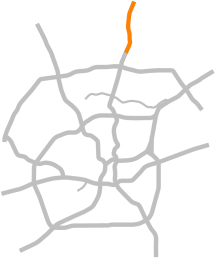
Since 2000, TxDOT had plans to upgrade US 281 north of Loop 1604 to a freeway. (
A freeway is a roadway with high-speed, divided mainlanes that go over or under intersecting roadways and access those roadways via entrance and exit ramps. It can be tolled or non-tolled.)
Due to a sudden funding shortage in 2003 caused by a spike in construction costs, the state updated their plans to use tolling of the new freeway lanes to fund the project, sparking a decade-long battle pitting the state against anti-toll activists and strange-bedfellow environmentalists.
With the passage of new funding measures for highways in 2013 and 2015, additional funding became available to drop the toll component of this project, resulting in a project including non-tolled freeway lanes, HOV lanes, and access roads.
Construction of the first phase began in July 2017 and was completed in late 2021. The second phase began in March 2019 with the last segment of mainlanes opening on May 19th, 2023.
Below is complete information about this project as well as its turbulent saga. Now that this project is completed, I'm leaving this page available as a reference on its history.
Project awards
The US 281 project has received several awards including:
- Associated General Contractors of America 2022 We Build Texas Award
- Construction Management Association of America 2022 Project Achievement Award
- American Council of Engineering Companies 2023 Engineering Excellence Award
On this page:
Completed project
Background
In 2000, TxDOT announced plans to upgrade 281 to a non-tolled, six-lane freeway from Loop 1604 to Stone Oak Pkwy., and to build a standalone overpass at Borgfeld Dr.,with long-term plans to upgrade 281 to a full freeway in phases all the way to FM 306 at the Comal/Blanco county line. However, rapid worldwide construction cost increases that developed suddenly in 2003 resulted in funding shortages for local highway projects, so the Texas Transportation Commission directed TxDOT to use tolling to fund new freeway projects wherever possible. As a result, this project was changed to include tolled mainlanes. This sparked a long battle with toll road opponents that delayed the project multiple times. (
See the history section at the bottom of this page for more details.)
In 2005, TxDOT accepted an unsolicited bid from a construction consortium of Zachary Construction and Spanish firm Cintra to build the 281 toll project at no upfront cost to the state. However, that project was cancelled shortly after work began due to a legal challenge that raised issues with the environmental clearances for the project.
In April 2014, after much legal wrangling and several restarts, the Alamo Regional Mobility Authority (ARMA), which had taken over the project from TxDOT, released the proposed schematics of an updated tollway concept. This alternative consisted of a bifurcated project. The southern half, from Loop 1604 to Stone Oak Pkwy., included two or three toll-free freeway lanes in each direction with one tolled managed lane in each direction in the center of the freeway and toll-free access roads. The northern half, from Stone Oak Pkwy. to Borgfeld Dr., consisted of two tolled freeway lanes in each direction and toll-free access roads. The Federal Highway Administration approved the project in August 2015.
During its 2013 and 2015 sessions, the Texas Legislature passed new funding sources for transportation (known as Prop 1 and Prop 7), which were subsequently approved by voters. The Alamo Area Metropolitan Planning Organization and the Texas Transportation Commission subsequently approved using San Antonio's share of the revenue from the new funding sources to pay for the US 281 project without using tolls, and TxDOT took the reins of the project back from ARMA. Because the physical footprint of the new toll-free project did not change substantially from the approved tolled project, no new environmental studies were required.
In May 2016, TxDOT released updated plans for the project, which subsequently became the final plans. These plans included two to four toll-free freeway lanes in each direction plus an HOV lane. In addition, it included the completion of the northern ramps for the Loop 1604 interchange.
This project ran from Loop 1604 to the Comal county line and was divided into two phases for construction, with Stone Oak/TPC as the dividing line for the two phases.
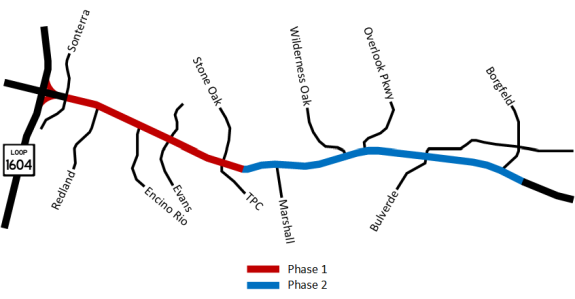
Project phases maps
PHASE 1: Loop 1604 to Stone Oak/TPC
- Timeline: Construction began in July 2017 and was completed in late 2021.
- The first section of new mainlanes (southbound mainlanes from Evans to Loop 1604) opened June 6th, 2020.
- The remainder of the mainlanes and the interchange ramps opened in phases over the following year, with the official ribbon-cutting on August 17th, 2021.
- Construction cost: About $180 million
This phase included the following:
- Eight (8) new non-tolled freeway lanes (i.e. four in each direction) south of Evans and four (4) new non-tolled freeway lanes (i.e. two in each direction) north of Evans
- Two (2) new high-occupancy vehicle (HOV) lanes (i.e. one in each direction) north of Evans in the center between the freeway lanes and separated from the general-purpose mainlanes by a four-foot striped buffer area; an elevated "T" ramp connects the HOV lanes directly to VIA's park & ride just south of Stone Oak Pkwy.
- Overpasses for the freeway and HOV lanes at Redland Rd., Encino Rio, Evans Rd., and Stone Oak/TPC Pkwy.
- Non-tolled access roads with a varying number of lanes
- An access road flyover northbound at Redland Rd. that allows through traffic on the access road to bypass the signalized intersection — this is utilized for traffic coming from Sonterra Blvd. to enter US 281 and by traffic exiting US 281 headed for Encino Rio
- Four northern flyover connectors of the US 281/Loop 1604 interchange
The new access roads were constructed first while traffic continued to use the pre-existing lanes. Once the access roads were completed, traffic was shifted onto them while the new mainlanes and overpasses were built. The superstreet configuration remained mostly in-place for the duration of construction, but was removed as the project neared completion (i.e. the intersections at Stone Oak Pkwy./TPC Pkwy. and at Evans Rd. now function like conventional intersections).
CROSS-SECTIONS
PREVIOUS
(Loop 1604 to Evans Rd.)
(Evans Rd. to Stone Oak Pkwy.)
CURRENT
(Loop 1604 to Evans Rd.)
(Evans Rd. to Stone Oak Pkwy.)
NOTE: In the cross-sections above, the number of access road lanes varies depending on location. Diagrams are for illustrative purposes only and are not to scale.
PHASE 2: Stone Oak/TPC to the Comal county line
- Timeline: Construction began in March 2019 and is substantially complete.
- The mainlanes were opened in phases, with the last sections of mainlanes opened on May 19th, 2023.
- The official ribbon-cutting was held on June 30, 2023.
- The southbound HOV exit to the Stone Oak Park & Ride requires some additional work before it can open. That work is expected to be complete soon.
- Construction cost: About $169 million
This phase included the following:
- Four (4) new non-tolled freeway lanes (i.e. two in each direction)
- Two (2) new high-occupancy vehicle (HOV) lanes (i.e. one in each direction) in the center between the freeway lanes and separated from the general-purpose mainlanes by a four-foot striped buffer area
- Overpasses for the freeway and HOV lanes at Marshall Rd., Wilderness Oaks, Overlook Pkwy., Bulverde Rd., and Borgfeld Dr.
- Non-tolled access roads with a varying number of lanes (typically two along most of this segment)
- A two-way, dead-end service road that connects the Borgfeld underpass to the various properties that front the east side of US 281 between Borgfeld and the Comal county line
As with phase 1, the new access roads were constructed first while traffic continued to use the pre-existing lanes. Once the access roads were completed, traffic was shifted onto them so the new mainlanes and overpasses could be built in the middle. Those mainlanes were then opened in phases as they were completed.
CROSS-SECTIONS
PREVIOUS
CURRENT
NOTE: In the cross-sections above, the number of access road lanes varies depending on location. Diagrams are for illustrative purposes only and are not to scale.
FAQ
Also see the HOV FAQ on the HOV lanes page.
- Is this project tolled?
No. Although earlier versions of this project proposed various tolled lanes, funding was secured to remove the toll component. Instead, non-tolled freeway mainlanes and HOV lanes have been added along with access roads.
- They should have built this instead of the superstreet.
When the superstreet was built in 2010, this project was not funded, and its environmental study was still underway and several years from completion. Congestion had reached extreme levels, so the superstreet was built as a quick-fix or "band-aid" to provide some immediate short-term relief, and it was always advertised as such. Since this expansion project was still several years from being shovel-ready, the only other alternative at that time was to do nothing.
- There needs to be at least three lanes in each direction north of Evans — two lanes will soon result in congestion like that on Loop 1604.
Planners look at current and projected traffic volumes to determine the number of lanes to build. The planning timeline is typically 20 years. Twenty years is about the longest that estimates can be considered reliable. Also, the lifespan of a road before it needs major repairs or reconstruction is also around 20 years.
Although nobody has a crystal ball and can tell what traffic volumes will be in 20 years, the best projections show that those two lanes (plus the HOV lane) will be sufficient. Today, the segment just north of Stone Oak carries about 55,000 vehicles per day. Even if that grows by 50% over the 20 years, that would put it at about the same traffic volume that is currently on SH 151 inside Loop 410, where the two freeway lanes in each direction experience no recurring congestion. And that doesn't take into account the traffic that will divert to the HOV lanes. For comparison, the section of Loop 1604 North between US 281 and I‑10 carries over 120,000 vehicles per day, more than double that on 281 north of Stone Oak.
- There are two mainlanes in each direction north of Stone Oak. There were already two lanes in each direction north of Stone Oak, so how is this an improvement?
Because the new lanes are freeway lanes, not surface road lanes. See the answer to the next question for a further explanation on why this makes a difference.
- Southbound between Stone Oak and Evans, there are two general-purpose mainlanes where there previously were three — this is a step backward!
This is a common misconception because it is not an apples-to-apples comparison. Yes, the section in question did indeed have three lanes before and now has only two freeway general-purpose mainlanes (plus an HOV lane). However, those new lanes are freeway mainlanes, not surface road mainlanes as they were before. Since freeway mainlanes do not have signalized intersections, they can carry about twice as many vehicles per hour than surface road lanes can. Therefore, the two freeway lanes are roughly equivalent to four of the previous lanes.
There will be a number of vehicles that will use the HOV lanes instead of the general-purpose mainlanes. With a minimum of two occupants per vehicle, this adds about the equivalent of two more lanes of capacity in each direction (maybe more with higher occupancies).
Also, a substantial portion of the traffic in the previous lanes in that area was headed to or from the intersecting roads or frontage businesses and will therefore now be on the access road lanes, not on the freeway mainlanes. Access road lanes are surface road lanes, which are a one-to-one equivalent to the previous lanes, so with a minimum of two access road lanes in each direction, that adds two more lanes to our running total. (Since access roads are surface lanes, you can think of the access roads as being the previous lanes just shifted outward.)
When you add that all up, the new lanes are approximately equivalent to eight surface road lanes in each direction, which nearly triples the number of southbound lanes and quadruples the number of northbound lanes for the section between Stone Oak and Evans. Even if you just count the raw number of lanes and don't account for the capacity differences for the types of lanes, there will still be a minimum of five lanes in each direction (two mainlanes, two access road lanes, and one HOV lane) as opposed to the previous three southbound and two northbound lanes, which is two to three more lanes in each direction than what was there previously.
(Commentary: The fewer lanes "fact" was disinformation often perpetuated by anti-toll and other activists either to intentionally misguide people or simply because they didn't know what they were talking about.)
CURRENT LANES BETWEEN EVANS AND STONE OAK
BECAUSE FREEWAY LANES CAN CARRY ~2X MORE
TRAFFIC THAN SURFACE ROAD LANES,
THE LANES ABOVE ARE EQUIVALENT TO THIS...
...WHICH IS A LOT MORE THAN WHAT WAS PREVIOUSLY THERE:
Project history
Prior to 1987, US 281 north of Bitters Rd. existed as a four-lane surface divided highway with traffic signals at major intersections. In 1990, TxDOT completed work to upgrade 281 to a six-lane freeway from Bitters to Loop 1604. North of 1604, the road remained as a four-lane surface divided highway with the only traffic signals at that time being at Encino Rio.
Since then, tremendous development has taken place along the 281 corridor north of Loop 1604 all the way to the SH 46 area in Bulverde. Meanwhile, US 281 in that area remained a four- and six-lane divided surface highway with several more signals added over the years due to safety and traffic demands.
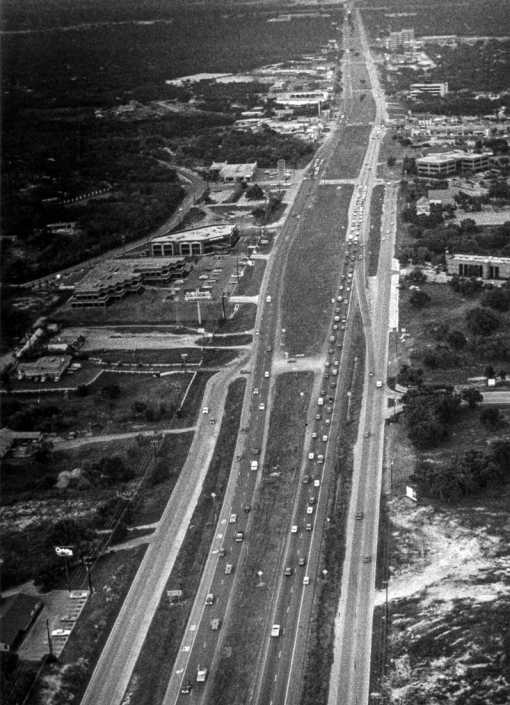
US 281 looking north near Bitters Rd. in 1986
The freeway ended here at this time.
(Photo courtesy of Jared Riley)
Original freeway plan
In 2000, TxDOT announced plans to upgrade 281 to a non-tolled, six-lane freeway from Loop 1604 to Stone Oak Pkwy., and to build a standalone overpass at Borgfeld, with long-term plans to upgrade 281 to a full freeway in phases all the way to FM 306 at the Comal/Blanco county line. At that time, the section from Loop 1604 to Stone Oak Pkwy. was listed by the Metropolitan Planning Organization (MPO) to be funded in 2003. However, due to a number of domestic and international factors, highway construction costs in early 2003 began a sudden and dramatic increase. As a result, the costs for the 281 project quickly exceeded the available funding, and the project was put on hold while officials evaluated their options.
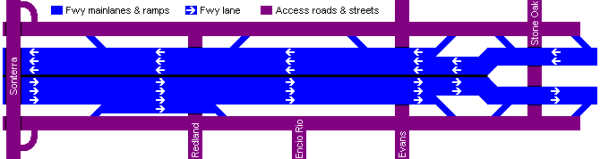
Schematic on this site ca. 2000 for the original plan to expand US 281
Note that no overpass was planned at Encino Rio.
Conversion to toll project
In December 2003, while TxDOT was regrouping to find additional funding for the project, the Texas Transportation Commission (TTC), at the behest of the governor and using new tools granted by the Legislature and
voters, responded to the soaring costs by ordering that "
controlled-access mobility projects in any phase of development or construction must be evaluated for tolling. This includes new-location facilities and increased capacity projects such as adding additional main lanes or constructing new main lanes." (
TTC Minute Order 109519) The order specifically included "
increased capacity projects such as...constructing new main lanes." Because the 281 project fit that description, TxDOT was compelled to evaluate it for possible tolling. That review showed that it was feasible for tolling, so per the TTC's order, the project was shifted to toll funding.
As a footnote to this, it is often asserted by toll road opponents that voters never approved tolling roads in Texas. However, in 2001, voters overwhelmingly approved
Proposition 15, which authorized the state to borrow money to build highways, including toll roads, which was clearly stated in the ballot language. It could be argued that voters did not understand the extent to which the state might use tolling, but given that toll projects are mentioned three times in the ballot language ("
turnpikes, toll roads, toll bridges"), it should have been evident to voters that toll projects could be a major outcome of approving this proposition. The referendum did not require approval from voters for specific projects, only approval of such by the Texas Transportation Commission.
Cintra-Zachary bid
Shortly after designating the US 281 expansion as a toll project, a consortium consisting of local construction giant Zachary and the Spanish infrastructure company Cintra — who were working together on a bid to build and operate one of the proposed
Trans Texas Corridor projects — submitted an unsolicited bid to TxDOT to build the 281 tollway project, as well as a similar Loop 1604 project, in return for a 50-year lease to operate them. Because the bid had merit, TxDOT was required to fully evaluate the Cintra-Zachary bid and open the project to other bidders. The Cintra-Zachary bid not only paid for construction and subsequent maintenance and operation of both roadways, which freed the previously-allocated state funding for other projects, it also paid a large concession fee to the state that could also be used to fund other projects. Based on those merits, the Cintra-Zachary bid was accepted in mid 2005. Since the project was to be built entirely with private funds, the tax funding that had been budgeted for it was reallocated to other highway projects in the area.
First lawsuit
Consequently, construction began on the Sonterra Blvd. to Stone Oak Pkwy. section in December 2005. Shortly thereafter, workers clearing land for the project accidentally broke a sewer line at Evans Rd. and 281. In January 2006, work was suspended indefinitely after environmentalists and toll opponents filed a lawsuit arguing that the project required a full (and costly) environmental impact statement (EIS) instead of the numerous, less-comprehensive environmental assessments (EA) that had been performed up to that time. Federal law only requires an EIS to be performed if an EA finds significant impacts, which the EAs for 281 had not. However, TxDOT and the Federal Highway Administration (FHWA), who were both named in the suit, jointly agreed later that month to cancel work on the 281 project, as well as the planned Borgfeld overpass, so that a consolidated EA for the entire corridor could be done and a categorical determination made of whether a full EIS would need to be performed. Consequently, the contract with Cintra-Zachary was terminated. In early 2007, TxDOT completed and released the new EA, which again showed no significant impacts. The FHWA approved the new assessment in August 2007, which authorized TxDOT to build the entire 281 project in Bexar County from 1604 to Borgfeld without the need for an EIS.
ARMA takes over project
In the meantime, the Legislature had passed legislation placing a moratorium on nearly all new privately-built and/or operated toll roads and requiring that local mobility authorities be given the right of first refusal on toll projects in their jurisdiction. The Alamo Regional Mobility Authority (ARMA), which was established by Bexar County in 2003, subsequently opted to take control of both the 281 and 1604 toll projects, and began planning to build the 281 project from 1604 to Borgfeld as a two-phased project starting in 2008. The MPO approved toll rates for the project in December 2007.
ARMA hires consortium
ARMA hired Cibolo Creek Infrastructure Joint Venture in May 2008 to design and build the 281 project. The consortium was headed by Fluor Enterprises of Irving, Texas, and Balfour Beatty Infrastructure Inc. of Atlanta, and included several San Antonio subcontractors. Contrary to pervasive public perception, this consortium — unlike the previous Cintra-Zachary group — included no foreign companies. ARMA was anticipating to start construction on the first segment, from Loop 1604 to Marshall Rd., in late 2008 or early 2009 with estimated completion in late 2010.
Second lawsuit
In February 2008, toll opponents and environmentalists once again filed a lawsuit challenging the second EA. After initial arguments, the judge ruled that the plaintiffs' case had sufficient standing to move forward with discovery. During the discovery process, TxDOT announced that they found a document that had been inadvertently omitted from the administrative record for the environmental assessment and asked for a 60 day stay to allow time to submit the document to the FHWA for review to determine if it would change the overall findings of the study. In early October 2008, TxDOT then reported that they had uncovered a conflict of interest with the contractor who had performed the endangered species portion of the study. Specifically, it was discovered that a TxDOT staff biologist was married to an employee of the company hired to do the a portion of the study. It was further discovered that the TxDOT employee's supervisor was aware of the situation and allowed it, but that controls put in place to mitigate the conflict were not enforced. Although it was determined that this likely had no impact on the results of the study, TxDOT asked the FHWA to revoke their environmental approval for the project to preempt an inevitable legal battle. Subsequently, the defendants (TxDOT, ARMA, and the FHWA) agreed to do a full EIS for the corridor, and the lawsuit was dismissed as moot in November 2008. In April 2009, ARMA hired a consultant to conduct the new EIS, bringing planning and engineering on the project to another stop.
Superstreet built
After the consortium project was scrapped, ARMA, TxDOT, and the City of San Antonio proposed several small short-term fixes that did not require environmental studies. Those proposed improvements consisted predominately of additional turning lanes and auxiliary lanes. Then in February 2009, another unsolicited offer for 281 emerged. This time, it was from local engineering firm Pape-Dawson, and it proposed a temporary fix for 281 in the form of a "superstreet" from Encino Rio to Marshall Rd. Their modeling showed that a superstreet would help ease congestion more than the turning and auxiliary lanes plans would and thereby provide some congestion relief while the EIS was completed. That plan was vetted, approved, and funded in mid-2009 and subsequently built in 2010.
Southern interchange built
During the Great Recession, Congress approved a national economic stimulus plan that poured additional federal money into road construction projects. In February 2009, the Metropolitan Planning Organization approved allocating San Antonio's share of the largesse to be used in conjunction with matching state funding for the first half of a 281/1604 interchange. This project built all four of the ramps connecting 1604 to 281 inside the loop, i.e. northbound 281 to both directions of 1604, and both directions of 1604 to southbound 281. The use of the federal funds allowed the ramps to be non-tolled. The TTC approved the state's share on March 5th, 2009. Construction began in early 2011 was completed in mid 2013. It was determined that the ramps connecting to 281 north of 1604 could not be built until the lingering issues stemming from the lawsuits and associated environmental studies for 281 north of 1604 were resolved. However, funding was identified for those ramps so that construction could begin as soon as the legal and environmental study issues were resolved and the design for US 281 was complete.
New managed lanes plan
In May 2012, local officials announced they had identified funding to expand US 281 from Loop 1604 to Stone Oak Pkwy with some non-tolled lanes. The working plan for US 281 included two to three non-tolled freeway lanes in each direction and one or two tolled managed lanes. The managed lanes would include direct access to a VIA park and ride facility being planned for the corridor. It was hoped that construction would begin sometime in 2014 or 2015 once the ongoing environmental study of the corridor was complete and barring any further legal challenges.
2014 funding plan
In January 2014, TxDOT and ARMA announced funding had been secured to expand US 281 from Loop 1604 to Borgfeld Dr. using a mix of non-tolled and tolled/managed lanes. Some funding would come from traditional tax-funded sources with the remainder coming from bonds backed by toll revenue. Funding was also allocated — mostly from a City of San Antonio bond issue — to complete the northern ramps for the Loop 1604 interchange; as with the previously completed ramps in the interchange, these new ramps will also be non-tolled. With funding now in hand for the entire corridor, construction was expected to start in late 2015 or early 2016 contingent on the approval of the environmental study that was scheduled to be complete in mid 2015. The funding for 281 was part of a larger financing package that included funds for proposed managed lanes on I‑10 from Loop 1604 to Ralph Fair Rd. and for a non-tolled freeway on Loop 1604 from SH 151 to US 90. In the summer of 2015, TxDOT submitted and the FHWA approved the completed EIS for the US 281 project.
Legislature approves new funding sources; tolling dropped
During its sessions in 2013 and 2015, with a statewide backlash building against tolling, the Texas Legislature approved new funding sources for highways. These changes allocate a percentage of sales taxes, motor vehicle sales taxes, and oil and gas production taxes annually to the state highway fund. The legislation also ended most of the budget "diversions" that sent money from the highway fund to fill holes elsewhere in the state budget. As a result, during the summer of 2015, several local officials indicated that should voters sign-off on the new financing in an election later that year, and the expected funding subsequently be allocated by the state, removing the toll component from the US 281 project would be the first priority. In early September 2015, the MPO approved a resolution to that effect, and the TTC approved the funding change later that month. In November 2015, voters approved the new funding source, and officials announced shortly thereafter that the plans for 281 would be updated to remove the toll component. It was also announced that the revised project would now include HOV lanes.
Additional state funding approved
In January 2016, the TTC proposed a $1.3 billion dollar funding largesse to help address congestion in the state's largest metro areas. San Antonio was awarded $171 million, of which $81.3 million was budgeted for the US 281 project north of Stone Oak Pkwy. This funding was mainly used for right-of-way acquisition and expediting the commencement of the project. In January 2017, the MPO allocated the remainder of the funding needed for the northern segment. The official groundbreaking for the southern phase of the project was held on March 31, 2017, and work started later that summer. The official groundbreaking for the northern phase was held almost exactly two years later on March 29, 2019.
Further north
Long-range plans are on the books to upgrade US 281 to a full freeway all the way to FM 306 at the Comal/Blanco county line. The first step toward that eventual plan upgraded 281 from a two-lane road to a four-lane divided highway from the Guadalupe River to FM 306; work on that project was completed in early 2015. The next project in the chute will upgrade the existing four-lane divided highway from the Bexar/Comal county line to SH 46 to a full freeway. Planning and design for
that project is now underway, but there is no current timeline for it.
Other sites of interest